lunes, 20 de diciembre de 2004

Mussels, wine, and an excuse to eat whipped cream

Everything I said about her is true, and more. Kate is dreamy, and so are her mussels—so tender! So sweet! So cheap! So full of crabs!

It was a crisp Sunday late afternoon, and my grumpiness was no match for the sun, shining persistently even as it set. I arrived chez Kate just in time to savor the spectacular view of Elliott Bay from her eighteenth-floor sublet before we rushed down to the market, slipping in just fifteen minutes before closing time. Strolling the wet brick streets under the Christmas lights, we collected our wares: big cans of whole stewed Italian tomatoes from DeLaurenti’s, a half-pint of cream and a shiny glass bottle of milk from the Pike Place Creamery, a baguette from Le Panier, and Italian parsley from the helpful guys at Frank’s Produce. At City Fish, the fishmongers—bundled in hooded sweatshirts and thick rubber aprons and knee-high boots—enthusiastically greeted Kate, a loyal customer, and we got “V.I.P.” treatment, paying only $3.00 for a generous bagful of clean, shiny Penn Cove mussels.

Back at home, we found a bottle of Chardonnay in the bottom of her fridge door, and I poured us each a glass as Kate began sautéing onions and garlic, making a broth with the dregs of a huge bottle of cheap white she’d been saving for just such occasions. To this she added most of a can of tomatoes and a touch of cream, and the mussels were put in to steam. They peeked open nearly instantly, and Kate ladled out big servings for each of us, scattering them with Italian parsley. The feasting began.
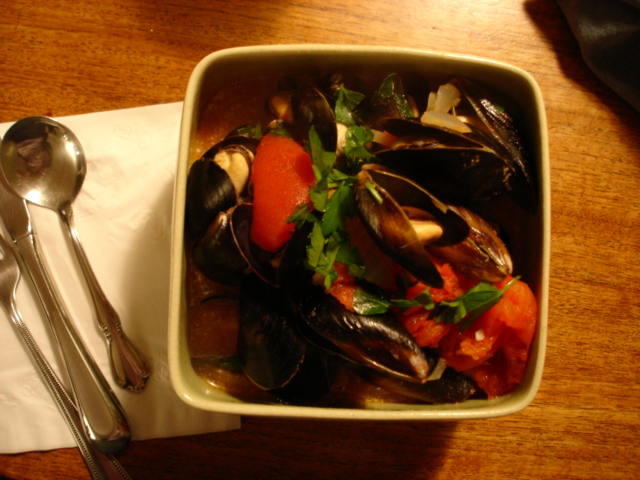


The empty shells clattered cheerily as we tossed them into the bowl in the center of the table, and we talked with our mouths full, alternating bites of meaty mussel with drippy chunks of broth-soaked bread. I’d tried to talk Kate out of buying bread at Le Panier, preferring a baguette with more chew and a thicker, more rustic crust, but she was right—this soft, fine-crumbed version was perfect for salty Plugra and for sopping up the winy, tomatoey juice. Best of all, lucky Kate found an unexpected bonus in one of her mussels: a very tiny but very scary baby crab, which she, shrieking in excitement and horror, proceeded to plunk onto her bread plate and who quickly became the evening’s third (albeit very still, very unresponsive, very cooked) participant.


But mussels and mini crabs are no match for my sweet tooth. Fortunately, earlier in the day, Kate had been given a very beautiful loaf of chocolate ginger banana bread. Under the watchful eye of the crab, we whipped a bowlful of cream with her wooden-handled whisk—in Kate’s family, everything is an excuse to eat whipped cream—and spooned it atop slices of the moist, cake-like bread.


Being generous, she didn’t say a word when I ate three slices, although I think she nearly matched me at two and a half and may have outdone me in cream consumption.

Ships floated by on the dark water, and we were very full.


Glenn’s Banana Bread with Chocolate Chips and Candied Ginger

Kate’s friend Glenn has been experimenting with candied ginger, and he had the wisdom to fold a handful of the stuff—along with chocolate chips—into a loaf of banana bread. The result is nearly impossible to stop eating, its dense richness cut by piquant studs of translucent golden ginger. He recommends using Trader Joe’s candied organic baby ginger, and he also makes a vegan version of this bread, for which the necessary substitutions appear below in parentheses.

1 cup granulated sugar (for vegan version, use raw sugar)
1 large egg (or 1 ½ tsp Ener-G Egg Replacer plus 2 Tbs warm water, says Glenn)
½ cup (1 stick) unsalted butter (or ½ c non-hydrogenated margarine), at room temperature
2 ripe medium-size bananas
3 Tbs milk (or soy milk)
2 cup unbleached all-purpose flour
1 tsp baking powder
½ tsp baking soda
1 cup chocolate chips
Small chunks of candied ginger, to taste
½ cup chopped walnuts, optional

Preheat oven to 350 degrees Fahrenheit. Grease a 9- by 5-inch loaf pan with butter or cooking spray, and set aside.

In a large mixing bowl, cream sugar, egg, and butter.
In a separate bowl, mash bananas; then mix with milk.
In another separate bowl, sift together flour, baking powder, and baking soda. Add flour mixture to butter mixture in three parts, alternating with banana-milk mixture in two parts, stirring by hand until just combined. Stir in chocolate chips, ginger, and optional nuts.

Turn batter into loaf pan, smoothing top with the back of a spoon, and bake for one hour, or until a toothpick inserted in the center comes out clean. Allow to cool for a few minutes; then remove bread from pan and cool on a wire rack.

domingo, 19 de diciembre de 2004

Cubic zirconia

Oh, the tenacious grumpiness that is mine!

Everything is a muted gray, inside and out; nothing bad—just subdued, monochromatic. And it's not just the rain. As someone I used to know once said, “Some days are diamonds, and others are cubic zirconia.” In my case, substitute “weeks” for “days,” et voilà.

But:


1. My apartment is so clean that I actually did eat something off the floor, just to be able to say that I had.


2. Kale is unspeakably beautiful, especially when barely wilted with olive oil and lemon. A sunny winter day on a plate. And it makes me feel so virtuous. Seattlites, go visit Willie Green's stand at the extended U-District farmers' (mini-)market, open every Saturday (except Christmas Day) through January 22, 10am to noon. What a nice guy, and what pretty potatoes and soulful leafy greens.


3. Happy birthday, Keaton! Last night, in the smoky sultry candle-lit Alibi Room, I was momentarily entertaining and engaging and non-grumpy, and that instant was recorded for posterity:


4. Tonight Kate is cooking a Pike Place Market dinner for me.


In exchange, and because I adore her, I’m reading her application essays for business school. She’s brilliant, an inspiration, a go-getter. And she’s steaming mussels. Bread will be dipped, juices slurped. I love being cooked for.


5. I’m boarding a plane bound for San Francisco on Tuesday night, armed with a bag of Hoppin’ John’s stone-ground grits (manna from the South, courtesy of my freezer), a jar of sourdough starter for Mom (who thinks she wants to bake her own bread but will likely be too busy; I indulge her nonetheless), a dozen jars of apple butter, and a handful of recipes. You, dear reader, will of course reap the benefits, albeit in a two-dimensional format. The family menu-planner is on her way, in more ways than one.


Soon.

[Sigh.]


viernes, 17 de diciembre de 2004

With my own two hands

Some nights were made for Jeff Buckley and my stove—many nights, in fact, and especially when the city is draped in a misty, blue-gray cloak of fog. Tonight I’m exhausted, but it only makes my singing voice more dramatic.

It’s the time of year when we all do lots of giving and receiving, and I’ve decided to do what I should have been doing for ages: make Christmas presents with my own two hands—in my kitchen, of course. My wallet is chronically malnourished, and anyway, my kitchen offers real benefits over the mall: no aggressive, blindingly sparkly decorations; no plastic figurines blaring carols; no tearing-out of hair over parking spaces; no sad, picked-over stacks of turtlenecks; no need to put on real clothing; and, best of all, easy access to nourishment and appropriately raucous or melancholy music. Sixteen pounds of apples, twenty-two Kerr jars, four cups of walnuts, two candy thermometers, several late nights, and more than a pound of butter later, I feel like a regular sugar-plum fairy. Unfortunately, because I’ve needed culinary advice and people to entertain me while I work, nearly everyone on my list knows what they’re getting for Christmas. But they’re not complaining, and wisely so.

And aside from all the other perks, I’ve learned an important lesson from all this Christmas craft-making: nothing (but nothing) is more satisfying that canning. Add this to the list of reasons why I’d make a good Depression wife. Thanks to Heidi from 101 Cookbooks, I’ve been able to transform apples, cider, lemon juice, sugar, cinnamon, and cloves into something lasting, a little jar that could—if you’re very careful and disciplined—sustain you through winter.


There’s something magical about a pot of fruit simmering on the stove, slowly darkening and thickening, growing shiny and smooth, becoming apple butter. Then there comes the ladle and the tongs, a cauldron of boiling water, and the gentle pop of the lid as it seals. If you repeat this process four times, as I did, you’ll have twenty golden-amber jars to line up on the counter and admire. It’s tempting to keep them all, like a squirrel hoarding nuts, but the stuff is so delicious—spicy, sweet, and with a zing of lemon—that you might want to give it away, if only for the compliments you'll get in return.

Speaking of compliments, my mother has long been legendary for her toffee, and with her blessing, I hope I'll soon be too.


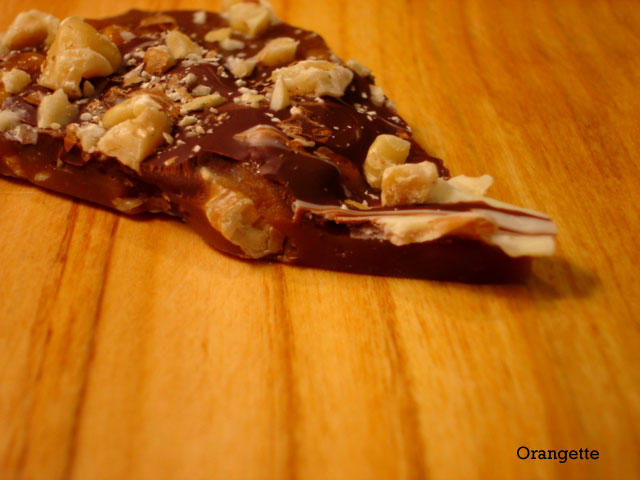
It's only slightly less addictive than crack, and infinitely tastier. Toffee lovers on coasts east and west, as well as in that skillet-shaped state called Oklahoma, have gushed over its deep caramel-coffeeness and toothsome crunch. It’s pretty too, its topcoat generously marbled with white and dark chocolates. And if you’re very lucky, it could snag you a choice gift at your holiday party at work, as it did for me:


So tonight I’ll stay in, out of the fog and away from the carols sung in electronic voices. I’ll open a bottle of wine, steal another taste of toffee, and perhaps do a little song-and-dance number on the linoleum in the kitchen, sticky though it is with apple butter splatters. Lady Frankenstein, however, will stay securely sealed in her plastic wrapping.

[Special thanks and many squeezes to Mom for the brand-new digital camera(!) and to Nicho for the beautiful handmade cherry cutting board, which makes a very sophisticated backdrop for the toffee above, no? I do love giving, but sometimes receiving is even better.]


Coffee-Walnut Toffee
Adapted ever-so-slightly from Bon Appétit Christmas (1994)

It may just be me, but anything that requires a candy thermometer seems daunting—and that’s even before taking into consideration the boiling, roiling, burbling sugar, something between molten lava and a swamp in a horror movie. But surprisingly, this toffee is remarkably easy and non-threatening to make, especially if you have your mise en place (your ingredients, prepped and measured) ready and waiting. If you’re like me, you’ll feel a goofy, giddy shiver as you happily dump into the pot little pre-measured bowlfuls of this and that, just like Julia or Martha would do. And remember, the candy thermometer is your friend. Trust it, and you’ll have a long, happy, toffee-filled holiday season.

2 cups walnuts
1 cup sugar
1/3 cup packed golden brown sugar
2 tsp instant espresso powder
½ tsp ground cinnamon
¼ tsp salt
1/3 cup water
1 Tbs dark unsulfured molasses
4 ½ ounces fine-quality bittersweet chocolate, finely chopped (I used Valhrona 64%)
4 ½ ounces fine-quality white chocolate, finely chopped (I used Callebaut)
1 ¼ cups (2 ½ sticks) unsalted butter

Preheat oven to 325 degrees. Spread walnuts on a cookie sheet and toast in the oven until fragrant, about 5-10 minutes, making sure they don’t burn. Allow to cool for ten minutes; then coarsely chop. Remove 1 ½ cups to a bowl. Finely chop remaining ½ cup; then place in a separate bowl.

Prepare your mise en place: in a medium bowl, combine sugars, espresso powder, cinnamon, and salt. In a small bowl or measuring cup, combine water and molasses. Place chopped chocolates in their own separate bowls.

Butter a cookie sheet or jelly roll pan. Melt butter in a heavy 2 ½-quart saucepan over low heat. Add sugars, espresso powder, cinnamon, salt, water, and molasses; stir until sugar dissolves. Attach a clip-on candy thermometer to side of pan. Increase heat to medium; cook until thermometer registers 290 degrees (and no less!), stirring slowly but constantly and scraping bottom of pan with a wooden spatula, about 20 minutes.

Remove pan from heat, and quickly stir in 1 ½ cups coarsely chopped nuts. Immediately pour mixture onto prepared pan; do not scrape saucepan. Tilt sheet so that toffee spreads to ¼-inch thickness. Sprinkle chocolates by generous tablespoonfuls atop toffee, alternating bittersweet and white chocolates. Let stand one minute. Using back of spoon, spread chocolates slightly. Using the tip of a knife or the tongs of a fork, swirl chocolates to create a marble pattern. Sprinkle with ½ cup finely chopped nuts. Refrigerate until toffee is firm, about one hour. Break toffee into pieces.

Makes about two pounds. Can be made two weeks ahead and stored in the refrigerator in an airtight container. Serve cold or at room temperature.

lunes, 13 de diciembre de 2004

Il faut cultiver notre jardin

“Pangloss disait quelquefois à Candide: ‘Tous les événements sont enchaînés dans le meilleur des mondes possibles; car enfin, si vous n’aviez pas été chassé d’un beau château à grands coups de pied dans le derrière pour l’amour de Mlle Cunégonde, si vous n’aviez pas été mis à l’Inquisition, si vous n’aviez pas couru l’Amérique à pied, si vous n’aviez pas donné un bon coup d’épée au baron, si vous n’aviez pas perdu tous vos moutons du bon pays d’Eldorado, vous ne mangeriez pas ici des cédrats confits et des pistaches.’

‘Cela est bien dit,’ répondit Candide, ‘mais il faut cultiver notre jardin.’”

—Voltaire, Candide

Like Voltaire’s Candide—who slogged his way to the good life through a haphazard and mind-boggling maze of hardships, mistakes, traps, and lost loves—I often wonder at the strange, seemingly slapdash chain of events that delivers us into each second of our lives. Take, for instance, the following: if I hadn’t gone to my dear Northern California college, I might not have gone to Paris in 1999; if I hadn’t gone to Paris, I wouldn’t have befriended Keaton; if I hadn’t befriended Keaton, I wouldn’t have felt so happily inclined to come to Seattle in 2002; if I hadn’t befriended Keaton and come to Seattle, I wouldn’t have met Kate; if I hadn’t met Kate, I wouldn’t have met Nicho; if I hadn’t met Nicho, I wouldn’t have been given bags and coolers full of his homegrown vegetables; and if I hadn’t been given those homegrown vegetables, I might not be here today, typing these words. I might well have starved to death, martyring myself in the name of rent payments and meager monthly contributions to NPR.

But as fate would have it, all but the last did miraculously occur. And today, I feel infinitely lucky to cultivate this Seattle garden, both human and vegetable. After all, we know it could have turned out otherwise.

As befits the season, I’ve recently been showered with Swiss chard and pumpkins, the garden's bounty. For Halloween, Nicho bestowed upon me a generous-sized pumpkin with a picture-perfect curly stem, cut from his yard that very afternoon. Then, a week or so ago, he called to ask if he could bring over "raw materials" and cook dinner with me. This, dear reader, ranks among the greatest questions in the history of mankind. You can well imagine my answer.

Nicho arrived twenty-four hours later with a bagful of Swiss chard, stubby dirt-flecked carrots, two enormous acorn squashes, and a bunch of mystery greens (which his mother claims is spinach, but it looked more like leafy geranium stems, minus the flowers). He also selected three varieties of sausage at Whole Foods, as well as a couple Belgian beers in tall glass bottles. He knows how I feel about sausage, and he delivers. That is friendship.

I need not tell you how delicious it was; that much is clear. But even better, later in the evening, after I saw him to the door, I discovered that the bag of Swiss chard remained, nearly full.

I slept very, very well.

The next evening, I cut the Swiss chard into a rough chiffonade and sautéed it with thinly sliced onion, stirred it into eggs beaten with salty grated cheese, and cooked it gently on the stovetop, a Swiss chard version of a zucchini-and-Pecorino frittata. It was barely golden, full of sweet onions and bitter greens. Delicious that night, it was even better as room-temperature leftovers, eaten on a couch in the art school café while talking applied anthropology and local scandal with Robert.

But Nicho’s pumpkin remained. It was aging well, although it took up acres of counter-space in my small kitchen. I knew it was a sugar pumpkin and thus ideal for baking, but I was indecisive: cheesecake? Pie? Bread? Then, one night shortly before Thanksgiving, Keaton arrived for cocktails with a pumpkin in her shirt, pregnancy-style; now there were two. The situation was dire. Not being a huge proponent of pumpkin pies and mousses, I set my sights on pumpkin bread, which offered the added benefit of perfuming my apartment with spice and toasted nuts.


A dusty orange color, spotted with crunchy hazelnuts and translucent golden raisins, the bread was tender and moist with a very delicate crumb. It’s sweet and spicy, with an earthy pumpkin flavor and a warm note of ginger. And it would make a lovely gift.

Go cultivate that garden.


Pumpkin Bread with Hazelnuts and Golden Raisins
Adapted from The New Joy of Cooking

1 ½ cups unbleached all-purpose flour
1 ½ tsp ground cinnamon
1 tsp baking soda
1 tsp salt
1 tsp ground ginger
½ tsp ground nutmeg
¼ tsp ground cloves
¼ tsp baking powder
1/3 cup water
½ tsp pure vanilla extract
6 Tbs unsalted butter, at room temperature
1 1/3 cups sugar
2 large eggs, at room temperature
1 cup pumpkin purée (or cooked, puréed—until very smooth—winter squash, yams, or sweet potatoes), at room temperature
½ cup coarsely chopped hazelnuts
1/3 cup golden raisins

Preheat the oven to 350 degrees. Grease (with butter or cooking spray) a 9- by 5-inch loaf pan.

Whisk together flour, cinnamon, baking soda, salt, ginger, nutmeg, cloves, and baking powder until thoroughly blended. In another bowl, mix water and vanilla extract. In a large bowl, beat butter until creamy, about 30 seconds. Gradually add sugar, and beat on medium speed until lightened in color and texture, about 3 minutes. Beat in eggs one at a time. Add pumpkin purée, and beat on low speed until just blended. Add the flour mixture in three parts, alternating with the water-vanilla mixture in two parts, beating on low until smooth and just combined. Scrape down the sides of the bowl with a rubber spatula as necessary. Fold in hazelnuts and raisins. Pour batter into pan and spread evenly across the top.

Bake about one hour, or until a toothpick inserted in the center comes out clean. Let cool in the pan on a rack for five or ten minutes before unmolding to cool completely on the rack.

Note: You’re not obligated to use a loaf pan, of course. You could make muffins, for example; for a standard-sized muffin, bake 18-20 minutes. And this bread freezes beautifully.

miércoles, 8 de diciembre de 2004

Granola: when darkness looms, or anytime

Winter in the Pacific Northwest means dusk at 3:30 in the afternoon, with sunset around 4:15. Six in the evening might as well be midnight. When I look out my rain-streaked window at 5pm, I’m met with the luminous glow of wet asphalt under the streetlamps in the grocery-store parking lot. So picturesque you are, Seattle.

These long, cold nights and short, dark days call for rousing breakfasts. We’ve all got to stoke the proverbial fire, but in winter such small rituals feel truly fortifying, somehow more deeply nourishing than during summer’s more carefree months.

That said, I should admit that — regardless of the season, gentle reader — each day I wake expressly for the purpose of eating the exact same breakfast.* Never mind the bus I’ve got to catch or the work to be done. Nothing can keep me from my crimson glass breakfast bowl.

Behold, the routine:
1. Get out of bed;
2. Put on fleecy black bathrobe;
3. Wash face and put in contact lenses;
4. Turn on NPR;
5. Enter kitchen;
6. Pour glass of water, preferably cool to cold;
7. Take down aforementioned bowl from shelf;
8. Deposit in bowl two handfuls of Heritage O’s cereal, a few spoonfuls of granola and a few of raisins, and big scoops of Brown Cow plain yogurt;
9. Thoroughly mix contents of bowl with spoon; and
10. Eat.

As mystic G. I. Gurdjieff said about something, “everything else is nothing.”

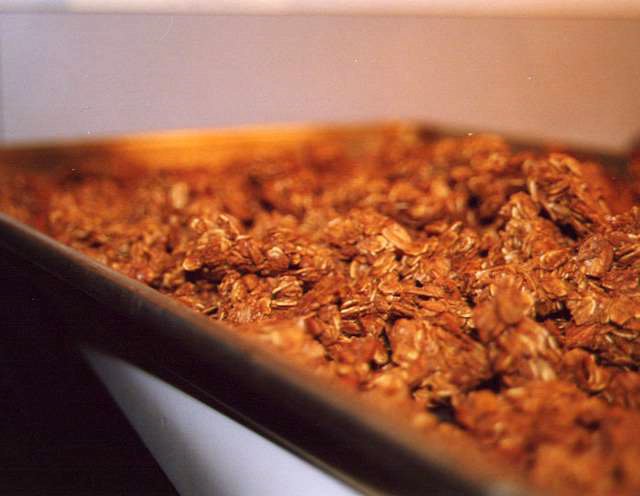
Now, maybe you're raising your eyebrows. Granted, this breakfast won’t win any awards for aesthetic value, and it certainly wasn’t crafted with what one typically thinks of as a gourmande’s spirit. But honey, it certainly fills the void within. And regardless of your stance on plain yogurt or health-foody cereals, this homemade granola is mighty toothsome: amber-brown, hearty but delicate, fragrant with cinnamon and orange zest, toasty with almonds.

Morning is not to be missed, even when it’s still dark outside.


*Sometimes there’s Irish oatmeal, but not often. There’s also the occasional homemade scone. But honestly, variety in breakfast food is overrated.


Rancho La Puerta Granola
Adapted from The Rancho La Puerta Cookbook: 175 Bold Vegetarian Recipes from America’s Premier Fitness Spa, with thanks to jolly Bill Wavrin


3 cups old-fashioned rolled oats
½ cup chopped raw almonds
½ cup sunflower seeds
¼ cup whole-wheat flour
¼ cup oat or wheat bran
1 Tbs ground cinnamon
¾ tsp ground ginger
¾ tsp ground cardamom
¾ cup honey
½ cup unsweetened, unfiltered apple juice
1 Tbs vanilla extract
2 tsp canola oil
2 tsp grated orange zest
2 Tbs fresh orange juice

Preheat oven to 250 degrees. Lightly coat a baking sheet with vegetable oil spray.

In a large mixing bowl, combine rolled oats, almonds, sunflower seeds, flour, bran, cinnamon, ginger, and cardamom.

In another bowl, whisk together honey, apple juice, vanilla, and oil until the honey is thoroughly incorporated. Add the orange zest and orange juice.

Pour wet ingredients over dry ingredients and mix well. Spread the granola evenly over the baking sheet and bake for 1 ½ to 2 hours, checking every 15 or so minutes. When the granola begins to brown, stir and turn over gently with a spatula. Take care that the outside edges do not burn. Your house or apartment should, by this point, smell spectacular. When golden and dry, scrape onto a cool baking sheet and set aside to cool. Granola will crisp as it cools. Store in an airtight container, preferably in the refrigerator.

martes, 7 de diciembre de 2004

Two years


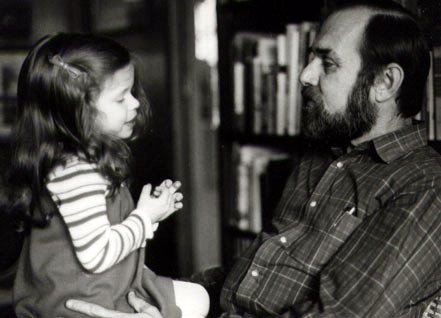
You may have heard me speak of my dad: the man I called “Burg,” the one who took me to Paris for the first time when I was only ten, introduced me to caviar long before puberty, revealed to me at sixteen the homely pleasure of rice pudding, and gave me a Cuisinart—carefully selected from his favorite shopping spot, eBay—for my 24th birthday. He loved to spoil me.

Today marks the two-year anniversary of Burg’s death to advanced-stage cancer of the kidney. He lived only ten weeks after his diagnosis. The disease had already spread to his spine and pelvis, skull, and legs. As a radiation oncologist who’d spent nearly fifty years treating and curing patients, his most poignant remark was, “What a kick in the ass.”

I miss him. Mostly I miss cooking with him, and for him. He was a man of many passions - from fly fishing to France, Gene Krupa to majolica, crossword puzzles, Dixieland jazz, dirty jokes, Dylan Thomas, and an old Alfa Romeo junker that sat in the driveway - but among the things he most adored were the kitchen and the eating, drinking, and laughter so vitally connected to it.

Some of my strongest memories of his illness - and of my last days with him - involve food, cooking for him and feeding him as he lay in a rented hospital bed in a room just off our kitchen. Though our family came together seamlessly to care for him, I often guarded for myself the task of preparing his meals: buttered rye toast, scrambled eggs with chevre, or reheated stew from the neighbors. I’d wake every morning to stir lumps of butter into his Cream of Wheat or half-and-half into his oatmeal, spooning it into his mouth in frantic disbelief as his belly - the target of many years of nagging - slowly melted away. As his pain worsened and the level of his medications increased, his eating grew more creative. One day, over a plate of eggs, he told me excitedly that we were in Italy having a picnic, and that when we finished eating, we’d go for a swim in the grotto. His hallucination blurring into reality, he called my scrambled eggs “Italian grotto eggs” from then on. I loved that. Somehow his brain, through the food on his plate, could bridge the gap between his blurry, transient dream-world and the very real present. I guess it was his way of leaving that bed, of escaping winter-locked Oklahoma, of fleeing the body that had carried him for 73 years and suddenly dropped him without warning.

Lying there, he traveled. We spoke French sometimes, his shaky command of the language better than it had ever been when he was well. One day, while searching for a phone number in his organizer, I happened to glance at the schedule pages from the previous spring, when he’d come to visit me in Paris, where I was living at the time. He’d written down the details of everything we’d done and nearly every meal we’d eaten: rhubarb clafoutis here, marinated fresh sardines there. I am no doubt my father’s daughter.

Some days his absence feels heavy, almost tangible. But most often I think of him in quiet celebration, with a sort of gratitude, a lightness. Burg loved words and puns and poetry; he’d be thrilled to see me writing. Or rather, I think he is thrilled. He’s around somewhere, watching - even when I wish he weren’t. In many respects, I write for him, for all the times at the dinner table when he’d lift his head, fork in hand, and exclaim, “You know, we eat better at home than most people do in restaurants!” My brother David and I used to tease him for it. I thought he was bragging. But I’d be lying if I said that Burg’s exclamation doesn’t ring true today, when I sit down to my own table. I know now what he was getting at. His silly old saying was - and is - a testament to the profoundly human joy of making and sharing food with the people you love. It’s a celebration.

Today I’d like to share a poem by James Wright, an American poet who died in 1980 after a very short but intense battle with cancer, like Burg. The year before his death, Wright spent nine months traveling in Europe with his wife, waking early to write poems. This poem is from a collection written during Wright’s final travels in Europe and published posthumously. My siblings and I all spoke or read at Burg’s memorial service, and this is what I chose. He would have loved the fact that this poem allowed me to say “making love” - while wearing fishnets, I should add, an edgy touch he would have also applauded - before a priest, a bishop, a rabbi, and an overflow crowd of 550 people in an Episcopal church in Bible-belted Oklahoma City. I am so my father’s daughter. I can almost hear him laughing now.


Yes, But

Even if it were true
Even if I were dead and buried in Verona
I believe I would come out and wash my face
In the chill spring.
I believe I would appear
Between noon and four, when nearly
Everybody else is asleep or making love,
And all the Germans turned down, the motorcycles
Muffled, chained, still.

Then the plump lizards along the Adige by San Giorgio
Come out and gaze,
Unpestered by temptation, across the water.
I would sit among them and join them in leaving
The golden mosquitos alone.
Why should we sit by the Adige and destroy
Anything, even our enemies, even the prey
God caused to glitter for us
Defenseless in the sun?
We are not exhausted. We are not angry, or lonely,
Or sick at heart.
We are in love lightly, lightly. We know we are shining,
Though we cannot see one another.
The wind doesn’t scatter us,
Because our very lungs have fallen and drifted
Away like leaves down the Adige,
Long ago.

We breathe light.

jueves, 2 de diciembre de 2004

Another excuse to talk biscuits

This Thanksgiving, the focus wasn't on the ritual turkey and stuffing; it was on a wedding engagement. After all, my (half-)brother David has certainly made us wait.

David was fifteen when I was born. A mid-seventies transplant from Baltimore, he took Oklahoma City by storm with his stylish and shiny Farrah Fawcettesque hair, striped knee socks, and devilish ways. Although he kept himself busy scandalizing various cities and defying death and teachers, he also took care to do the requisite brotherly things: asking me (à la Telly Savalas), “Who loves ya, baby?” and training me to say, “You do!”; sitting on me and tickling me until I couldn’t breathe; harassing me about boys; and giving me a beer-derived nickname, Molson. The Kojak game is now long over, though it was only around age fourteen that I was able to convince David that tickling is not okay. And as for the harassment, it has today happily morphed into a lively banter, at times risqué enough to make him flinch. He pauses, gives me a high-five, and then returns the off-color punch. And of course, I’m still Molson.

But we’ve been waiting. He’s not getting any younger, and Carée is a fantastic catch, to say the least: strong, smart (a professor of health and human sexuality, complete with tabletop condom trees and penis light-switches), pretty, sophisticated, willing to tolerate David’s goofiness, able to put him in his place, and well-versed in dirty martinis. So finally, one blustery weekend last winter, he got down on literal and proverbial bended knee and offered up a very impressive diamond. Carée, caught straight out of the shower in a bathrobe and towel-turban, bravely accepted.

And this past weekend, we celebrated.

David and Carée arrived in Oklahoma City on Thanksgiving Day with a cooler full of Malpecq oysters, which David shucked using our father’s tried-and-true oyster knife. We gathered around the butcher-block island in the kitchen, Champagne flutes in hand, everyone but (scaredy-cat) me loudly slurping oysters. Watching David and Carée together, I was struck by how solid he seems with her, how confident, playful, happy he is. My mother tells me that he wants to have speakers installed in the kitchen of the house he and Carée have just bought: he wants to be able to kitchen-dance. It's so beautiful.

But all this was only a prelude: the true celebration came Saturday night, when forty or so of my parents’ friends joined us to fête David and Carée’s engagement. David cleaned up—even taking off the backwards baseball cap, his daring gang-member look—to resemble the suave businessman he is, and Carée looked gorgeous in a sleeveless, cowl-neck dress. I got to play hostess (a talent I prize but use far too infrequently) and managed to work the crowd for over two hours without getting a face ache from too much smiling. But best of all, there were biscuits—sweet-potato biscuits.


For as long as I can remember, we’ve had sweet-potato biscuits with ham and Honeycup mustard (“Uniquely sharp!” the label warns) on the party rotation. For this particular occasion, Mom did a bit of research and found, via David Rosengarten, what is purported to be the finest ham in all of America: Murcer’s bone-in ham from Enid, Oklahoma. It was indeed a lovely, honey-tinged, and luminously rosy specimen, redolent of smoke, its aroma wafting up from the kitchen into my father’s bathroom, where I was prettifying for the evening’s festivities. Paired with a generous slathering of Honeycup mustard on a buttery sweet-potato biscuit, it was intoxicating. The bartender also kept my wine glass very full.

Faithful readers may have noticed that I’ve been talking biscuits a lot lately, but with winter’s cold closing in and many dark months ahead, consider all this buttery richness a pre-emptive strike against hypothermia. As my French host-father used to say, “C’est nourrissant!” So allez, mangez: come spring, you’ll thank me. Carée, with wedding-dress fittings no doubt menacing, will not.

Congratulations, you two.


Sweet-Potato Biscuits
(Adapted slightly from Martha Stewart)

1 3/4 cups all-purpose flour
2 Tbs light-brown sugar
2 1/2 tsp baking powder
1 tsp salt
1/2 tsp baking soda
6 Tbs chilled unsalted butter
3/4 cup chilled sweet potato puree (read: peeled, boiled, and pureed sweet potatoes)
1/3 cup buttermilk

To make the dough:
In a large bowl, whisk together 1 3/4 cups all-purpose flour, 2 Tbs light-brown sugar, 2 1/2 tsp baking powder, 1 tsp salt, and 1/2 tsp baking soda. With a pastry blender or two knives (or not-too-warm fingers), cut in 6 Tbs chilled unsalted butter, cut into pieces, until mixture resembles coarse meal, with some pea-size lumps of butter remaining. In a small bowl, whisk together 3/4 cup chilled sweet potato purée and 1/3 cup buttermilk; stir quickly into flour mixture until combined (do not overmix).

To shape the biscuits:
Turn out dough onto a lightly floured surface, and knead very gently until dough comes together but is still slightly lumpy, five or six times. (If dough is too sticky, work in up to 1/4 cup additional flour.) Shape into a disk, and pat to an even 1-inch thickness. With a floured 2-inch biscuit cutter, cut out biscuits as close together as possible. Gather together scraps, and repeat to cut out more biscuits (do not reuse scraps more than once).

Baking the biscuits:
Preheat oven to 425°, with rack on lower shelf. Butter or spray an 8-inch cake pan. Arrange biscuits snugly in pan. Brush with 1/2 Tbs melted butter. Bake until golden, rotating once, 20 to 24 minutes.

Yield: 8 biscuits.