martes, 18 de enero de 2005

The city of intrepid palates

Intensive training in anthropology and ethnographic methods has taught me the delicate art of participant observation, and, because it’s a shame to let these things atrophy, I feel compelled to exercise my skills every now and then, or constantly. I’m the one in the grocery check-out line who’s fervently studying the contents of your cart, the one quietly noting behavior on the bus. Most recently, using my best eavesdropping and staring skills, I’ve compiled an informal and quite accidental study, and the results are promising indeed. With a sample size of two and no further delay, I’m happy to announce, dear Seattle, that your children are of unrivaled sophistication. They’re very significant, statistically.


For example, I recently overheard the following conversation between a little girl and a man in the produce department of Whole Foods:


Man: “What kind of apples do you want?”

Girl: “Chocolate apples!”

Man: “I don’t think they have that kind….”


This is a child of unparalleled vision. And thank heavens, because this is just the sort of leader we need in these sorry times. Unfortunately, we’ll have to wait a few years and hope, in the meantime, that she’s not quashed by bland and tiresome adults, such as the inferior specimen accompanying her.


On Sunday night, I had the pleasure of dining with another model of refinement, a towheaded fifteen-month-old named Eero, the son of my friends Jenny and Thomas. When he’s not having his diaper changed or toddling around with a book in his fists, Eero is putting away spoonfuls of plain yogurt and mounds of roasted broccoli, raw red peppers, mangoes, and persimmons. He loves to drink fizzy water from his mother’s (glass!) cup, and he even springs for raw fennel, so long as he can take it like a little bird—standing in the kitchen, flapping his arms, stamping his feet with impatience, and opening his mouth wide.


Sunday night was no exception. While Jenny and I bustled around their cozy kitchen, putting the finishing touches on a homemade galette des rois,* whisking béchamel and whipping egg whites for a pumpkin-and-goat-cheese soufflé, shaving fennel for a salad, and chatting, Eero played with a head of radicchio and the bowl of the food processor. One should never underestimate the importance of being comfortable in the kitchen from an early age.


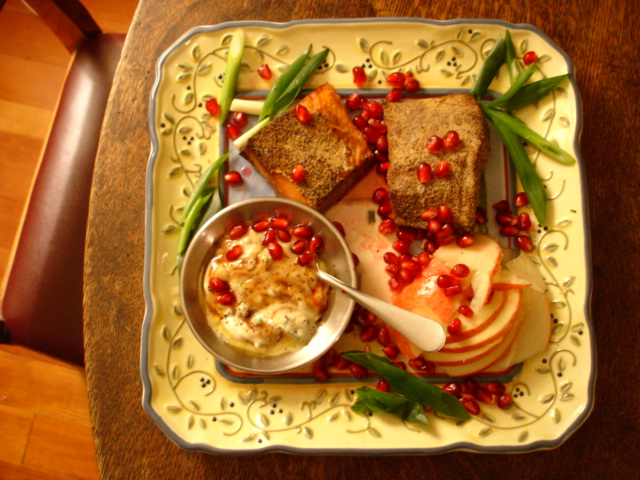
While the soufflé did its mysterious work in the oven, we sat down for a quick sip of white wine around a gorgeous hors d’oeuvre platter Jenny had improvised before my arrival.


It was stunning: two peppery hunks of salmon, caught and smoked by one of Thomas’s brothers; a pile of thinly shaved apple; a smattering of pomegranate seeds and slices of scallion; and a small bowl containing an ingenious mixture of mayonnaise, walnut oil, minced scallion, and pomegranate molasses. Listening for the oven timer, we cut thick slices from a crusty loaf of bread and piled them high with salmon, fruit, scallions, and the nutty, punchy mayonnaise. At one corner of the table, chunks of salmon and bread disappeared at an alarming rate into Eero’s little body. And he wasn’t finished. In the half-hour that followed, he got himself around two and a half servings of pumpkin soufflé and some plain yogurt topped with apple butter. I stared shamelessly. After all, as a kid, I was no Eero.


I’ve not yet determined what one must do to produce this sort of “intrepid palate,” as Jenny calls it. Perhaps there's something in the Seattle city water supply? Or a strategic coital position? Further studies and staring will be necessary. But when my time comes, I’m aiming high. I’m aiming for chocolate apples. I’m aiming for Eero.


*Dorie Greenspan’s Paris Sweets strikes again!


domingo, 16 de enero de 2005

On industry, indolence, and Italian vegetable soup

Every now and then, something comes over me, and I produce. With no real hunger or purpose, I make, say, three mini-loaves of fancy banana bread, a batch of strawberry scones, a loaf of sourdough, and barrelfuls of Italian vegetable soup—all in less than twenty-four hours, and mostly on a Friday night, no less. Behold the pinnacle of geekiness! But because a girl’s got to keep these things in check, I usually make sure that my bouts of industriousness are immediately followed by a good dose of sloth, generally in the company of someone upon whom I can foist some of the products of my labor. Hence Saturday night’s languorous session on the couch, spooning whipped cream and sipping wine, wearing unusually wavy bedroom hair, and snorting and guffawing in intentionally bad French with Kate. Whoever said that sloth is a deadly sin has obviously never spent an evening with us.

I arrived at Kate’s with a heavy bag of loot: a crusty homemade sourdough boule, my jagged-toothed Wüsthof bread knife, a wedge of bleu d’Auvergne from my personal ripening cellar (a.k.a. the refrigerator), a baggie of scones, and a Tupperware full of still-warm soup. Taking stock of our wares and coming up short, we ran down to DeLaurenti’s, barraged the poor wine saleswoman with inarticulate questions about Italian reds, and returned to Kate's with a bottle of Argiolas Perdera Isola dei Nuraghi 2002, jammy, spicy, and as fun to pronounce as it is to drink. I set the table—complete with the few napkins I didn’t set on fire at my birthday dinner—while she washed lettuce and handfuls of peppery watercress. With rain falling on the cold streets outside, we sat down to a warming winter dinner: steaming bowls of soup, hearty with carrots, cabbage, zucchini, Swiss chard, and sweet white beans,

and, on the side, greens with vinaigrette, creamy bleu d’Auvergne, and chewy bread.

And, because we needed to meet our regular whipped-cream quota, we collaborated on a now-routine-but-still-exhilarating gâteau au chocolat fondant, which, incidentally, gave me a chance to show off my natural grace in the kitchen. Not only did I drop a chocolate-batter-covered spoon on the floor and nearly knock over a pitcher of kitchen utensils while making the thing, but, once it was out of the oven and cool, I shot a knife across the kitchen trying to serve it. I just get so eager.

Kate, on the other hand, whipped the cream with uncommon elegance.

We collapsed onto the couch and, wine glasses and bowl of cream nearby, made fast work of the cake. Then, in only a couple of hours, we planned our entire lives and a cocktail party. Even in times of slothfulness, we can’t help but be productive.

And what’s more, before I left, we even took out the trash.

The rubbish chute is the highlight of every visit chez Kate. I adore it, and, knowing this, Kate saves her very best trash just for me. I’ve thrown into the chute's greedy mouth everything from a candy-coated apple to a bag full of mussel shells, and I can’t get enough of the clicketty-clacketty-THUMP! of trash tumbling down through the darkness. It’s pure heaven. Someday I’ll have a rubbish chute of my own, and I’ll fulfill my dream of sliding down it. I’ve long had visions of putting myself in small, confined spaces: cabinets, the space under airplane seats, and so on. When I was moving into my current apartment, I crawled into a corner cabinet in the kitchen and had my mother close the door behind me. It was strangely satisfying, if only for a few seconds. A rubbish-chute ride would surely be divine, if painful.

Coming home and sighing contentedly, I gave thanks for so much industry and indolence by turning out the light and tumbling down through the darkness to my bed.


Fretwell (Italian Vegetable) Soup

This soup recipe comes from the Fretwell family, longtime friends in Oklahoma, and they in turn discovered it somewhere in Italy. I have only a blurry Xeroxed copy of the recipe (which the Fretwells had faxed to them from wherever they first ate it), and so I thus cannot give credit here to its original author. That’s a true shame, because this is one of the most delicious vegetable soups I’ve ever tasted. The Fretwells brought us many meals while my father was ill, and this was one we requested repeatedly. But consider yourself warned: this recipe makes a veritable cauldron of soup. If you don’t have a stockpot that can hold twelve quarts or so, do this in two batches, or halve the recipe.


1 ½ lbs. dried cannellini or Great Northern beans
Olive oil
Salt
2 or 3 fresh sage leaves
1 or 2 garlic cloves, peeled and left whole
2 or 3 medium yellow onions, chopped
8 medium carrots, sliced into ¼-inch coins
5 celery stalks, trimmed and sliced into ¼-inch crescents
2 medium zucchini, halved lengthwise and sliced into ¼-inch half-circles
1 bunch red Swiss chard, washed, dried, and sliced
½ head green cabbage, cored and chopped roughly
1 quart vegetable broth (I used Imagine brand)
1 28-oz can whole peeled tomatoes, juices reserved and tomatoes chopped roughly


Soak the beans overnight. The next day, drain them, put them into a large pot, add water to cover by 2 inches, and cook, with sage and garlic, for about one hour. As the beans cook, skim off any white foam that rises to the surface, and halfway through their cooking time, add ½ Tbs salt.

Heat 2 or 3 Tbs olive oil in a large soup pot, add onions, carrots, and celery, and sauté for 10-15 minutes, stirring occasionally, salting lightly, and adding more oil if necessary. Add the zucchini and the vegetable broth, cover, and bring mixture to a simmer. Then add Swiss chard, cabbage, tomatoes, and tomato juices. Cover the pot, and simmer over low heat for half an hour or so. Add the beans and their cooking water, salt to taste, and simmer, covered, over low heat for one hour, stirring occasionally. Taste and adjust seasoning as needed. Serve over slices of day-old crusty bread, and garnish with a drizzle of olive oil if you like.

Serves scads—but scads!—of people.

miércoles, 12 de enero de 2005

Outline of a Theory of Cabbage

Be warned: I’m baring my geek stripes. If you’re of weak constitution, please avert your eyes.

Since our lengthy discussion of soufflé, I’ve spent a lot of time thinking about cabbage. After all, whenever I’m plotting a soufflé for dinner, cabbage inevitably shows up, usually bringing its posse of caraway seeds, vinegar, and an apple or two. It doesn’t take much to convince me to eat this humble crucifer, and anyway, the unctuous, dairy-rich egginess of a cheese soufflé truly has no better match than the sweet-tart earthiness of braised cabbage. I think a lot about these sorts of things, and about social science. And that’s where things get geeky.

Today, while riding the bus home from work and school, I wracked my brain for a way to “pitch” cabbage to you, skeptical reader. Surely I don’t have to tell you that, in the U.S., the cabbage is woefully misunderstood. Never mind the fact that German kids are eating sauerkraut as soon as they have teeth, or that corned beef and cabbage may well be the best thing to come out of Ireland, ever. Here it is roundly reviled, or at least disliked enough to permit me this slight exaggeration. So as the bus rattled north toward home and dinner, a silent conviction took shape within me: cabbage must be defended! What we have here is cabbage under siege! Cabbage must no longer be linked to discipline and punishment; no, it’s part of the natural order of things! By the time we arrived at my stop, I had it: an outline of a theory of cabbage.

Dear reader, you know that it’s time to close the book on graduate school when even vegetables call to mind famous works of social theory, such as Michel Foucault’s “Society Must Be Defended,” Discipline and Punish, and The Order of Things; Zygmunt Bauman’s Society Under Siege; and Pierre Bourdieu’s Outline of a Theory of Practice. I wince just typing this, and I pity my poor companions on the bus, who I probably blinded with the blazing rays of geekiness emanating from my feverish brain.

But I’m deathly serious about this defense-of-cabbage business. Nearly everyone I consider a friend shares my appreciation for it, and I wouldn’t be the least bit surprised if our friendship were in fact based upon some cabbage lover's force field we mutually exert upon each another. And on some level (far below consciousness until this writing), I’ve been putting men to “the cabbage test” for years: I’ve eaten the stuff in some form or other with every man I’ve taken seriously, and honey, it works every time. Often they're okay with geekiness too.

So, when you start daydreaming about what to serve with your soufflé (or anything else, for that matter), please give this theory a try: I hold that, under both controlled and uncontrollable conditions, one who tries braised red cabbage with apples and caraway seeds will come back begging for more,


and the same goes for an even simpler preparation, sautéed green cabbage with apples and red onions.


A Pinot Noir would be nice as well, and a bookmark.


Braised Red Cabbage with Apples and Caraway Seeds
Adapted from The All New Joy of Cooking

2 Tbs olive oil
3 Tbs finely chopped red onion
1 small head red cabbage (about two pounds), quartered, cored, and very thinly sliced
1 large Granny Smith apple, peeled, cored, and coarsely grated
3 Tbs apple cider vinegar
2 Tbs honey
1 tsp salt
1/8 to ¼ tsp caraway seeds


Heat oil in a large, nonreactive skillet or Dutch oven over medium-low heat. Add onions and cook until translucent and slightly golden. Add cabbage, apple, vinegar, honey, salt, and caraway seeds; then cover pan and cook over medium-low heat, stirring occasionally, until the cabbage is very soft but not falling apart, about an hour.

Serves roughly 4. Delicious warm, at room temperature, or cold, straight from the fridge.


Sautéed Green Cabbage with Apples and Red Onions
Adapted from Chez Panisse Vegetables

Olive oil
1 medium red onion, very thinly sliced
1 medium green cabbage, quartered, cored, and very thinly sliced
1 large crisp, sweet apple, such as Golden Delicious, cored and very thinly sliced
Salt
Pepper
Apple cider vinegar

In a large sauté pan or Dutch oven, heat a little oil and sauté onions until translucent and just beginning to brown. Add the apples, and sauté one minute, or until everything is sizzling. Add the cabbage, the salt and pepper, a dash of vinegar, and a little water. Stir over high heat just long enough to barely soften and cook the cabbage, a few minutes. It should retain a little crunch but lose the raw flavor of uncooked cabbage. Adjust seasoning, and serve.

Serves 6 to 8. Delicious warm or at room temperature.

domingo, 9 de enero de 2005

On soufflé and trepidation

In this world, there are plenty of things to be afraid of, but soufflé is not one of them. We know all too well the horror of a natural disaster, the freak accident, the uncertainty of change, the fearful dwindling of the bank-account balance, the sleep lost to worries and wondering. For me, there’s a special terror reserved for the blast of a tornado warning siren: evidently, my Great Plains youth still haunts me. But if there’s one thing that won’t keep me up at night, one thing that I can count on, it’s soufflé.


I ate my first soufflé as a preteen, at Oklahoma City’s swank but sedate Coach House Restaurant. It was an apricot soufflé, tall and trembling, served in a small ramekin. The waiter, deathly serious, plunged a silver spoon into its center and poured a thin stream of translucent apricot sauce into the chasm. I scooped up a spoonful: the soufflé was airy, eggy, and sweet, with a thin crust of sugar where it met the ramekin’s edge. Everything went quiet. I didn’t speak until I’d scraped up every bit from the ceramic dish and licked my spoon clean.

But a dozen years would pass before I’d try my hand at making one. After all, everyone knows that soufflés are notoriously difficult. According to the word on the street, your soufflé will be nothing more than a scrambled-egg discus if you: a) open the oven before it’s finished baking; b) over-whip your egg whites, c) under-whip your egg whites; d) turn your back while it’s baking; e) don’t worry enough; or f) worry too much. It’s terrifying. To draw on Allen Ginsberg’s “Howl,” “I saw the best minds of my generation destroyed by soufflé, starving / hysterical naked, / dragging themselves through the streets at dawn looking for a whisk….” If I’m going to sweat and twitch, it shouldn’t be over dinner.

But, dear reader, because there’s nothing more luxurious and magical than a good soufflé, we can’t let ourselves be beaten down by fear. We’ve at least got to try. In this life of uncertainty, we’d be wise to heed the words of another poet, William Stafford:*


Yes

It could happen any time, tornado,
earthquake, Armageddon. It could happen.
Or sunshine, love, salvation.

It could you know. That's why we wake
and look out—no guarantees
in this life.

But some bonuses, like morning,
like right now, like noon,
like evening.


Yes, some bonuses, like soufflé. Heartened by these words, one night in late 2003, I took my soufflé dish down from the shelf. Little did I know it would be the opening of a new era. Armed with Julia Child’s masterful The Way to Cook, I was ready, and it was a simple matter of following instructions. From the béchamel to the stiff peaks, it was straightforward, even easy(!). In a show of defiance to fear, I even drank a glass of wine while it baked. And when I pulled it from the oven, golden and soaring, I knew it was a sure thing. I brought it to the table and served it proudly, breaking the crust and listening with glee to the crackly hiss of a spoon through delicate webs of pillowy egg. It was both ethereally light and fantastically rich with cheese. A bonus indeed.

There’s not a second to waste. After all, it could happen any time: tornado, earthquake, Armageddon, soufflé.


*From The Way It Is: New and Selected Poems (Graywolf Press, 1998).


Cheese Soufflé
Adapted from The Way to Cook, by Julia Child

Thank heavens for Julia.


2 Tbs finely grated Parmigiano Reggiano, or other hard cheese
2 ½ Tbs unsalted butter, plus more for buttering dish
3 Tbs all-purpose flour
1 cup whole milk, hot
½ tsp paprika
A pinch of nutmeg
½ tsp salt
3 grinds of freshly ground pepper
4 egg yolks (from large eggs)
5 egg whites (from large eggs)
1 cup (3 ½ ounces) coarsely grated cheese, such as gruyère or sharp cheddar


Generously butter a 7 ½- to 8-inch diameter soufflé dish. Roll the grated Parmigiano Reggiano in the buttered baking dish to cover the bottom and side. Set the oven rack in the lower third of the oven, and preheat to 400 degrees Fahrenheit.

To make the béchamel:
Over moderate heat, melt 2 ½ Tbs butter in a 2 ½-quart saucepan; then blend in the flour with a wooden spoon to make a smooth but somewhat loose paste. Stir until the butter and flour foam together for two minutes without coloring to more than a buttery yellow. Remove from heat. When the bubbling stops, in a few seconds, pour in the hot milk all at once, whisking vigorously to blend. Place the saucepan over moderately high heat, whisking rather slowly, reaching all over the bottom and sides of the pan, until the sauce comes to the simmer. Simmer two to three minutes, stirring with a wooden spoon, until the sauce is very thick and coats a spoon nicely. Whisk in the seasonings, and remove from heat. Whisk the egg yolks into the hot sauce one by one, transfer sauce to a large bowl, and set it aside.

To finish:
In a clean bowl and with clean beaters, beat the egg whites to stiff shining peaks. Scoop a quarter of the egg whites into the bowl with the sauce, and stir together with a wooden spoon. Turn the rest of the egg whites on top; rapidly and delicately, fold them in with a rubber spatula, alternating scoops of the spatula with sprinkles of the coarsely grated cheese. Pour the batter into the prepared baking dish, and use your spatula to trace a circle in the top of the batter, just inside the rim of the dish. This will help the soufflé to rise freely.

Place the soufflé in the oven, and turn the oven temperature down to 375 degrees Fahrenheit. Bake about 25 to 30 minutes (without opening the oven), until the soufflé has puffed one to three inches over the rim of the baking dish and the top has browned nicely. Serve immediately, because yes, it will deflate within a few minutes. To serve without crushing it, use two serving spoons pointed down and back-to-back; plunge them into the crust and tear it apart.

Serves four.

viernes, 7 de enero de 2005

Sugar High Friday #4, or how I got my hands on a pain de Gênes

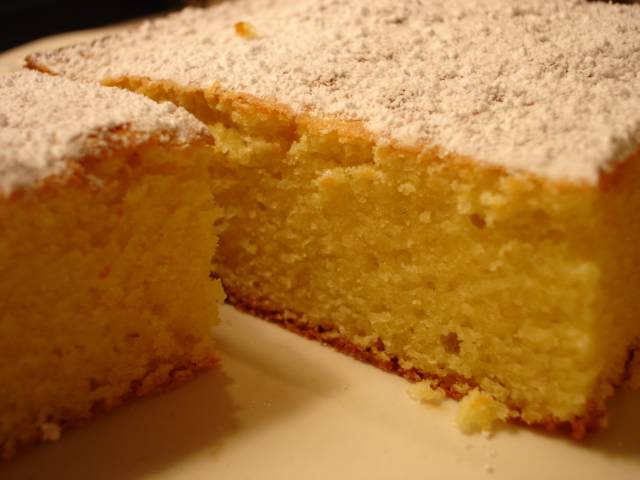
It was a circuitous route that brought me to le pain de Gênes, the sunny yellow French cake rich with butter, eggs, and almond paste,


and I never would have made it without a former New York cabbie and his Citroën.


It all began one day in the mid-1990s, in the parking lot of an Albertsons grocery store in Oklahoma City. My father, the ever-willing food shopper, paused with his grocery bags to admire a Citroën parked near his (beloved but ridiculously unreliable) Alfa Romeo. Because Burg was that sort of guy, he struck up a conversation with the owner of the Citroën, and, to make a short story shorter, they became best friends.


Every Saturday for years to follow, Burg and Michael would go for a morning walk together, leisurely strolling the neighborhood for an hour or so and finishing with an elaborate lunch, never without a frothy beer or a bottle of wine. Michael was a transplanted New Yorker, a cab driver turned writer and, with his partner Becky, a successful business owner. Intense and pensive, he devoured books of poetry and loved encouraging me—then an angsty, slightly punk, and borderline nerdy teenager—in my own stunted “career” [she writes, wincing] as a poet.


Michael was also a tremendous cook, and he loved feeding us in his airy kitchen with its dark wood floor and cabinets. He often prepared dishes that he and Becky had discovered in their nomadic hippie days in Mexico, and I still get weak-kneed just thinking of his roasted Coca-Cola chicken with hominy and his boiled yucca with olive oil and sea salt. We'd talk Adrienne Rich or poems about popes and poodles until it came time for dessert, when all attention would turn to Becky, an artist and skilled baker. As it fate would have it, one evening in late 1997, after another simple but haunting meal, Becky served an almond cake. Plain and unpretentious, it was rich and dense, imbued with sweet almond. I quite nearly scrapped my plans of leaving for college—my kingdom for almond paste!—just so I could stay there and eat the stuff forever.


But I didn’t. Life continued apace, albeit sans almond cake. And years later Michael and Becky, ever nomadic, moved to Paris, which is only appropriate, for it was there that I was reunited in fall 2001 with my lost love of the cake variety, what I would come to know as a pain de Gênes.


I’ve always felt pretty lucky, but Fortune really smiled on me when she gave me apartment only a few blocks from Au Levain du Marais, one of the best boulangeries in Paris. Occupying an ornately tiled corner space on boulevard Beaumarchais (at rue du Pasteur-Wagner, just north of Place de la Bastille, 11th arrondissement; also at 32, rue de Turenne, 3rd arrondissement), Au Levain du Marais is best known for its fine baguettes and its crusty, rustic pain au levain. I, of course, partook liberally of these, but I also acquainted myself with the pastry case, driving the women behind the counter crazy with my perpetual whimper, “Euh, euhhhh…j’ai du mal à choisir...euhhh...” (Uh, uhhhh…I’m having trouble choosing...uhhh...).


One day, I spotted a buttery-looking square of yellow cake behind the glass, topped with a snowy dusting of powdered sugar. Pointing to it eagerly, I asked for its name. It was a traditional pain de Gênes (“Genoa bread”), I was told, a cake made with almond paste—those two magic words!—invented to commemorate the 1800 siege of Genoa, when the city’s inhabitants survived largely on almonds.* Without a moment’s hesitation, I ordered a piece and carried it home gently, tucking my nose under the neatly folded, butter-soaked paper wrapper for a whiff of almond paste, heady and almost liqueur-like. After years of abstinence, there could be no keeping us apart.


In the time since, I’ve certainly eaten my fair share of Paris’s pain de Gênes, but here in Seattle, I’ve yet to find a bakery that offers it. But I’ve got two hands, a decent kitchen, a stack of cookbooks, and a Whole Foods at my disposal. So when Viv of the illustrious Seattle Bon Vivant announced that nuts were to be the theme of Sugar High Friday #4, I, nearly panting with anticipation, wasted no time.


After consulting a few recipes, I settled on the “Montmartre Square” in Dorie Greenspan’s fantastic Paris Sweets, which, if you are an aficionado of la pâtisserie, you must buy. Having been too kind to steal my mother’s KitchenAid stand mixer last Thanksgiving, I borrowed one from my generous next-door neighbors, and, at long last, I had a humble and painfully delicious pain de Gênes in my very own kitchen. From the first bite, I couldn’t help myself: my most visceral French—only the finest in slang, gleaned years ago from a reggae-jivin’ Parisian boyfriend—came rushing forth: “J’hallucine grave! C’est trop bon!” (I’m seriously trippin’! It’s too good!). It’s in moments like these that I’m at my most eloquent. Michael would surely be proud of the little poetess in me.


*For more information, see Dorie Greenspan’s Paris Sweets, pages 38 and 52, and the introductory paragraph here.


Montmartre Square with a Few Changes, or Pain de Gênes

Adapted from Dorie Greenspan's Paris Sweets


This is one of two slightly spiffed-up versions of a pain de Gênes featured in Greenspan's book. I've de-spiffed this one a bit, leaving off the almond-paste cloak that covers the original. Someday I'll try it as it's written, but I'm awfully partial to just a homey dusting of powdered sugar. Also note that Greenspan recommends using a stand mixer for this, since the cake batter is beaten for a full fifteen minutes—plenty long enough to wipe out the usual handheld beaters.


¼ cup all-purpose flour

2 ½ Tbs potato starch (available in the baking section of must supermarkets)

14 ounces soft, pliable almond paste (I used two tubes of Odense brand), broken into pieces

4 large eggs

1 stick (4 ounces) unsalted butter, melted and cooled (but still liquid)

1 Tbs Grand Marnier or kirsch (I used Jim Beam; honey, work with what you’ve got)

Powdered sugar, for dusting


Center a rack in the oven and preheat oven to 350 degrees Fahrenheit. Butter an 8-inch square pan (preferably metal, with nice, straight sides and corners), dust the inside with flour, tap out the excess, and put the pan on a baking sheet.


Sift the flour and potato starch together and set aside. Put the almond paste and two of the eggs in the bowl of a mixer fitted with the paddle attachment and beat on medium speed for five minutes. Scrape down the sides of the bowl, remove paddle, and put whisk attachment in place. Return the mixer to medium speed and beat in the remaining two eggs one at a time. Once eggs are incorporated, beat the batter for another ten minutes, scraping down the bowl frequently, until the batter is creamy. It should remind you of mayonnaise.


Stir a couple of tablespoons of this batter into the cooled melted butter. Reduce the mixer speed to low and beat in the Grand Marnier, followed by the dry ingredients, mixing only until just incorporated. Using a rubber spatula, gently fold in the butter.


Turn the batter into the prepared pan and bake for 35-40 minutes, or until the cake starts to pull away from the sides of the pan and a knife inserted in the center comes out clean. Remove cake from the oven, unmold onto a cooling rack, reinvert if you like, and cool to room temperature.


Dust powdered sugar (through a sieve or special powdered sugar shaker, if you have one) onto the top of the cake. Serve.


domingo, 2 de enero de 2005

Feeding a cold: chicken stew and oliebollen

Since Christmas morning, I’ve been nursing a mild but persistent cold, the sort of thing that manifests itself in unladylike snorts every few minutes and a nasal bedroom voice by early evening. It hasn’t slowed me down, but it’s made soup sound exceptionally good. So this New Year’s Day, I shelved my tentative plans for good-luck black-eyed peas masala and opted instead for a cauldron of rustic chicken stew.


And because it was indeed a cauldron, I invited my favorite Dutchman, he who crafts beautiful cutting boards, spoils me with sausage and greens, and boasts woodsman biceps as big around as my head. [And I don’t take this last lightly, seeing as the diameter of my head is pretty large; when I was little, I’d wind up in tears every time my mother tried to put me in a turtleneck.]


Nicho arrived, as is now the norm, with Swiss chard and a bag of dog food for Index, who trotted in happily and curled up on the floor in the hallway. I put a small pot of stew on the stove to reheat and cut thick slices of the Essential Baking Company’s Columbia Bread, brushed them with olive oil, and slid them into the oven to warm and crisp. Nicho set to work cleaning and chopping the chard,


which we sautéed quickly with olive oil, a dash of white wine, sea salt, and—at Nicho’s wise suggestion—a few dabs of Dijon mustard stirred in at the very end.


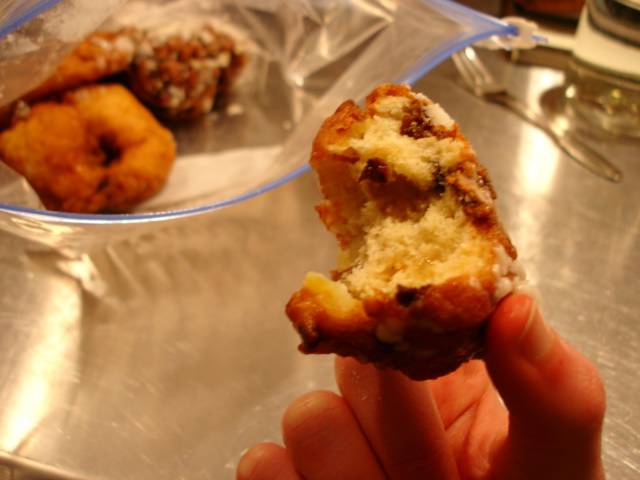
We sat down to deep, wide bowlfuls of stew ladled over the crisped bread, which slowly swelled with broth and yielded deliciously to our spoons. Nicho’s mustard chard made a wonderfully earthy and complex side-note, and we scraped our bowls and plates contentedly, talking between slurpy mouthfuls, watching Index sleep alarmingly soundly at Nicho’s feet. Then, rising to clear the dishes, Nicho presented me with a suspicious pink-and-white striped Victoria’s Secret box, hinting only that what lay within “could be worn.” Tucked beneath a layer of pink tissue paper I found a Ziploc bag full of homemade oliebollen and appelbeignets, doughnuts traditionally served in Holland to celebrate the New Year. And wear them I did—in my belly.


The oliebollen (which translates enticingly to “oily balls”) were cakey, dense, and only slightly sweet, freckled throughout with currants and golden raisins,


and the appelbeignets were surprisingly light, a round slice of apple tossed in cinnamon, coated in batter, and fried to golden.


I can only imagine how treacherously delicious they were the night before, fresh from the fryer and still warm. Nicho blames them for his so-called “winter chub,” which, by all appearances, does not exist and anyway is seasonless, having been a topic of conversation since early fall. He was admirably restrained, only eating half an appelbeignet, but I threw caution to the wind and downed one and a half oliebollen and the other half of his appelbeignet. After all, I’ve got the old “feed a cold; starve a fever” thing on my side.


Chicken Stew with a Secret Weapon


My half-brother Adam and his kitchen-savvy wife and kids made this stew for our family the day after Thanksgiving 2004, when we all needed a low-key, soothing, and restorative dinner. They based their recipe on one created by Jody Adams, a well-known Boston-area chef, and they served it ladled over big pieces of olive-oil-rubbed and grilled baguette. It was absolutely slurp-worthy—comforting and familiar, rustic yet sophisticated.


Recently, my sister-in-law Susan sent me a link to one version of Adams’ recipe, and through a bit of Internet searching, I found another version that resembles even more closely the one they served me. My own version falls somewhere in between the two, featuring, among other things, the addition of a Parmigiano Reggiano rind. An old trick favored by Italian grandmothers, it’s my secret weapon for adding body, richness, salt, and a round, luscious aroma to soups. And if you need a back-up weapon, slip Q and Not U’s Different Damage into your stereo while cooking. It’s delicious too.


3 large, bone-in, skin-on chicken breasts (roughly 3 lbs, preferably free range)

Olive oil

Salt

Freshly ground black pepper

Fresh thyme (about 10-12 sprigs)

2 quarts chicken broth (I used Imagine brand Organic Free Range), plus a bit more broth or water for thinning if needed

3 large carrots, cut into rounds roughly ¼-inch thick

3 medium leeks, trimmed, halved lengthwise, rinsed thoroughly, and cut into rough 1-inch pieces

1 Parmigiano Reggiano rind, roughly 2 inches square

1/3 cup tiny soup pasta (I used Ronzoni brand acini pepe, but you could also try stelline, which takes me instantly back to the Campbell’s Chicken and Stars of my childhood)


Preheat oven to 450 degrees Fahrenheit. Rinse and dry chicken breasts, and place them in a single layer in a baking dish. Rub them with olive oil, and sprinkle them with salt, pepper, and roughly 3 sprigs’ worth of thyme leaves. Roast the chicken for 30 minutes, or until it is cooked through and the skin is golden. Set the meat aside until cool enough to handle; then shred the chicken from the bone in large flakes, discarding the skin. [Note, however, that most of the seasonings are stuck to the outside of the skin, so as you remove it, you might consider rubbing it, seasoning side down, against the meat.]


Pour chicken broth into a large pot, Dutch oven, or stockpot. Add the carrots, leeks, cheese rind, and a dash of salt. Bring to a boil, reduce to a simmer, and let cook about 25 minutes, until vegetables are tender and broth smells lightly of the cheese. Add the leaves of 7 or so sprigs of thyme, and let cook another five minutes. Add chicken and pasta (and a bit of additional broth or water, if you feel the mixture is too thick), return the soup to a boil, turn down the heat, and let the soup simmer for 5 minutes. Taste for seasoning, and add more salt and pepper if needed. Retrieve and discard the cheese rind. Ladle into bowls.


Serves a lot.

sábado, 1 de enero de 2005

2005: The first meal and a trend predicted

Two thousand five has officially arrived, bearing hip-shakin’ hip-hop, sparkly lights for the Space Needle, an unwelcome nuzzle, and tater tots.

Seeking a relatively low-price, low-key New Year's Eve celebration with the possibility of dancing, three of us traipsed down Fremont Avenue to a hip-hop show at Suite G. I stuck to gin and tonic—not quite ginny or limey enough, but then again, the bartender was no David Rosengarten—and Teresa took quite a liking to the “Strasberi Drop,” while Megan sampled the “Bird of Paradise.” Featuring crème de cacao, amaretto, something else I’ve forgotten, and cream (reassuringly billed as “fresh”), it was dessert in a martini glass. I wanted desperately to fill a bathtub with the stuff and roll around in it, although Megan seemed to prefer the idea of dipping herself in her aunt’s banana cream pie.

Over the hubbub (“This is it, WHAT! Blue Scholars in the place—put your fist up! Doin' it large to bring in 2005, y’all!”), we talked bacon fat, pulled pork, lamb-chop sideburns, wild animal desire, and anthropology. I made the mistake of accidentally catching the eye of a fairly drunk-looking but otherwise handsome man as he passed us, and he generously rewarded me with a warm and scary neck-nuzzle. Blessedly soon thereafter, the clock struck midnight and we, weary after so much stimulation, snuck out in search of something greasy.

Late-night, rain-slicked Fremont doesn’t offer much, but we did find an auspicious first meal of 2005 in a basketful of chips with salsa and guacamole at Dad Watson’s,


and Megan demonstrated the proper way to eat a tater tot with Ranch dressing.


Now, perhaps you’re wondering at the lack of Champagne, caviar, and other highfalutin celebration fare, but think again: tater tots, I’ve been told, are the noblest form of potato. Apparently, these crunchy little barrels of potatoeyness are no longer to be frowned upon or shoved aside with other unsightly flashbacks of the school cafeteria. I believe, dear reader, that we're witnessing the birth of a trend, and in fact, 2005 may well turn out to be the year of the tater tot. But frankly, I’m undecided. I’m a little afraid of what might be lurking within, of what lies behind that über-potato flavor. I sense the work of a laboratory. But I did make fast work of the tortilla chips.

And then, perfectly sober, I knocked a glass of ice water into my lap while doing a seated shimmy to Michael Jackson’s “Wanna Be Startin’ Somethin.’”

Thus began 2005, already making good on promises of thrills, adventure, and salty snacks and treats. Happy New Year to you and yours. May you be warm, dry, and well-fed.