sábado, 19 de febrero de 2005

Pâte brisée for a pillow

I know it’s been said about all sorts of things, but this is the stuff that dreams are made of. I mean it.


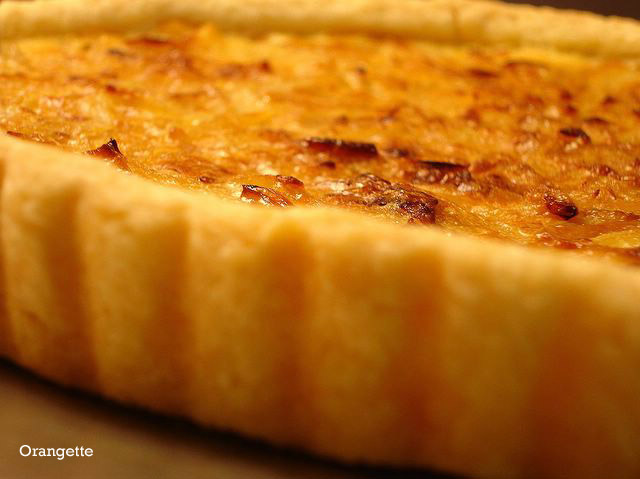
Our recent discussion of eating, sleeping, and breathing food got me thinking, a dangerous activity that inevitably ends with me hunched over a pile of open cookbooks and recipe clippings. In that post, I’d mentioned a roasted-onion tart that once came to me in a dream, beckoning from a shelf in a bakery window, its thick topknot of translucent onion gleaming under the lights. Unfortunately, I’ve never seen its exact likeness in my waking life, but dear reader, I’ve come close. If the onion tart in my dream was, let’s say, the Platonic form of onion tarthood, its real-life copy is the Alsatian onion tart. And deep within my accordion file of clippings lies the recipe.

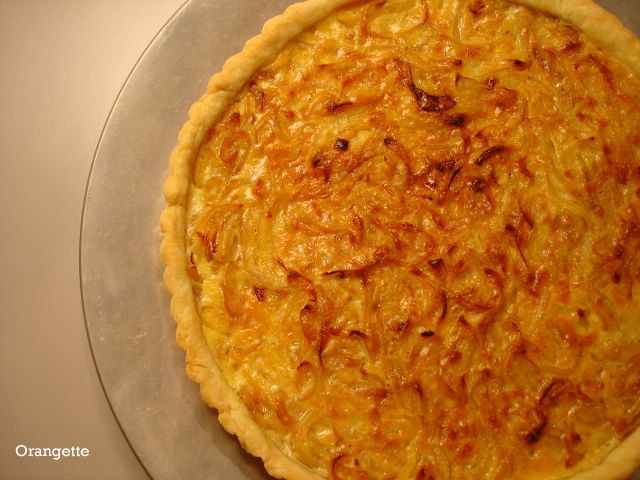
A specialty of the Alsace* region of northeastern France, la tarte à l’oignon is perfect winter fare: delicate but rich, sweet but earthy, light but grounding. I made it for the first time—and then over and over and over again—last winter. It begins with a hefty amount of thinly slivered onions, sautéed until lightly caramelized and then doused with a mixture of egg and heavy cream, poured into a tart shell, and baked to golden.


Every onion comes into the world hoping to find its end in this tart. As the French would say, “C’est mortel!” (It’s killer!). Me, I say it’s just plain dreamy. I’d like to stretch out on its bed of onions and custard and rest my head on a firm pillow of pâte brisée. Never mind the little details, like the shards of buttery pastry in my hair. One could find worse places to hibernate for winter.


*Alsace is also, incidentally, the home of choucroute garnie, a traditional dish of sauerkraut and various forms of pork. Those Alsatians are brilliant.


Tarte à l’Oignon, or Alsatian Onion Tart
Adapted from André Soltner in The New York Times, October 20, 2003

No matter what recipe she was talking about, my father’s mother—a little Jewish woman from Poland with dyed red hair and a thick accent—would always begin by saying, “First, you brown an onion.” Too bad she never got to taste this tart. It makes a nice lunch or a light supper when served with a simple green salad, some good bread, and a crisp, dry Alsatian white wine, such as Pinot Blanc.


1 half-recipe Martha Stewart’s pâte brisée without sugar (flaky pie dough; enough for one 9” tart shell), unbaked
1-2 Tbs olive oil
1-1 ½ lbs yellow onions (about 2 large), peeled and very thinly sliced
1 large egg
½ cup heavy cream
Salt
Freshly ground pepper
Grated nutmeg

Preheat the oven to 375 degrees.

Roll out the pâte brisée, and line a 9” removable-bottom tart shell with it. Cover it with plastic wrap, and chill it in the refrigerator.

Heat the oil in a large skillet over medium heat, and sauté the onions, stirring regularly, until they are lightly golden—just beginning to caramelize—and tender. Remove the skillet from the heat.

In a small bowl, beat the egg and cream together. Add a pinch or two of salt and pepper and a pinch of nutmeg. Add this to the onions, stirring to combine.

Remove the tart shell from the refrigerator, and fill it with the onion and egg mixture. Bake tart for 25 minutes, or until the filling is golden brown and set. Serve hot or warm.

Serves 5 to 6.

miércoles, 16 de febrero de 2005

The simple and the unsexy

After a weekend of cream puffs, a girl’s got to take a breather.
Moderation is horribly unglamorous, I know. But, dear reader, I also know that you’re the sort who values truth—ugly, unwashed, morning breath and all.

I’ll give it to you straight: I channel the USDA food guide pyramid. I don’t mean the new recommendations announced last month, which are well-meaning but unrealistic at best—three cups of dairy products per day for the average adult?!—but rather the concept of the food pyramid. I’m not sure how this came to be, but I’m crazy about the five major food groups. I love them equally, the way a mother loves her children. Brussels sprouts speak to me as sweetly as crusty bread, and to my ears, the crunch of an apple is as good as the sizzle of a roasting chicken. Nurse Flinn must have done an exemplary job of teaching health class back in third grade. Someone needs to tell her that I’m still waiting for my hard-earned A+ gold star stickers.

Now, this is not to say that I don’t have fried chicken dreams, or that I can forgo dessert. I think I’ve made it amply clear that I go weak in the knees before any number of things sweet, jammy, fruity, nutty, buttery, crunchy, cakey, creamy, or frozen. But I also want my roasted cauliflower, my grains, and a hunk of beast. I want it all, damn it. If life itself is the proper binge, as dearly departed Julia once said, I've got to make room for everything. Enter that boring “m” word, that thing I mentioned in the first paragraph. If I'm to be civilized and presentable, I must have my daily dark chocolate, but not enough to have me moaning and slumped on the floor. Not often, at least. Well, you know me. Ahem.

The foods and recipes I feature most often on Orangette aren't fancy or complex. I love to eat as much as the next guy, but I also love simplicity—honest food that nourishes, that lets ingredients speak for themselves. And that features all five food groups. Truth be told, the majority of my meals consist of simple, unsexy staples: this winter it's pungent, buttery, melting fontina on coarse bread; unruly greens braised into submission; and, of course, cabbage, the season’s princely toad. Sometimes nothing is more welcome than a sunny-side-up egg, flecked with salt and freshly ground pepper, blanketing a bowlful of red lentil dal. And lately, there’s been a parade of citrus. Around here, it’s an (heirloom navel) orange a day, perfumed and spicy, spraying bitter orange oil over my fingers and wrists; and after a late, loud, smoky night out, I’ve been known to sneak a slathering of lemon curd on whole wheat toast before bed—your typical rock ‘n roll gourmandise.

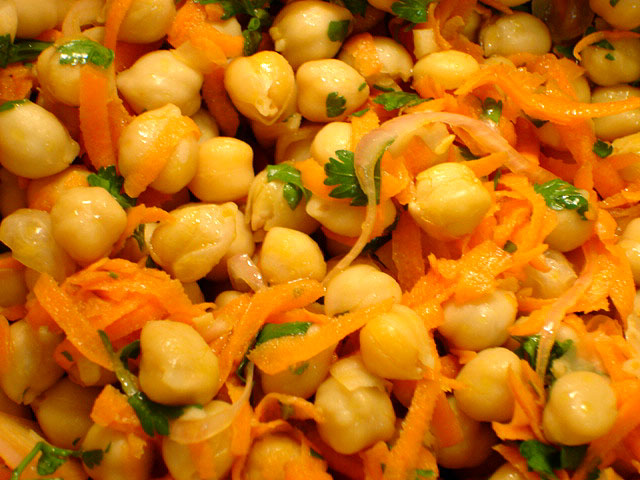
And this week, after so much whipped cream and whatnot, I’m reaching for warm chickpea salad.


Another standby from Lynne Rossetto Kasper’s Splendid Table Weeknight Kitchen newsletter, it’s earthy and clean, sweet with shredded carrots and punchy with red wine vinegar. It’s horribly unglamorous and completely delicious, the sort of thing that makes you want to dive headlong into the bowl—and then have cream puffs for dessert.
Ahem.


Warm Chickpea Salad with Shallots and Red Wine Vinaigrette
Adapted from The Splendid Table Weeknight Kitchen, which in turn excerpted from Fresh Food Fast: Delicious, Seasonal Vegetarian Meals in Under an Hour

Lynne Rossetto Kasper recommends serving this with a leafy tossed salad, but I also like it with braised or sautéed winter greens. Either way, be sure to have a loaf of crusty bread alongside. Leftovers keep beautifully in the fridge and make for tasty lunches.

1 large shallot, thinly sliced
3 Tbs red wine vinegar
1 garlic clove, minced
¼ tsp sea salt, plus more to taste
2 (15-ounce) cans chickpeas, drained
1 large carrot, coarsely grated
½ cup flat-leaf (Italian) parsley leaves, chopped
1/3 cup extra-virgin olive oil
Freshly ground black pepper

In a large bowl, combine the shallot, vinegar, garlic, and salt. Set aside for 10 minutes to allow the shallots and garlic to mellow.

In a medium saucepan over high heat, bring 2 quarts of water to a boil. Add the chickpeas, and blanch for a minute or two. Drain.

Add the carrot, parsley, and olive oil to the shallot mixture. Toss in the chickpeas, and season as needed with salt and pepper. Serve immediately, while still warm.

Serves four.

domingo, 13 de febrero de 2005

Bagnette, breasts, and an excuse to eat pink whipped cream

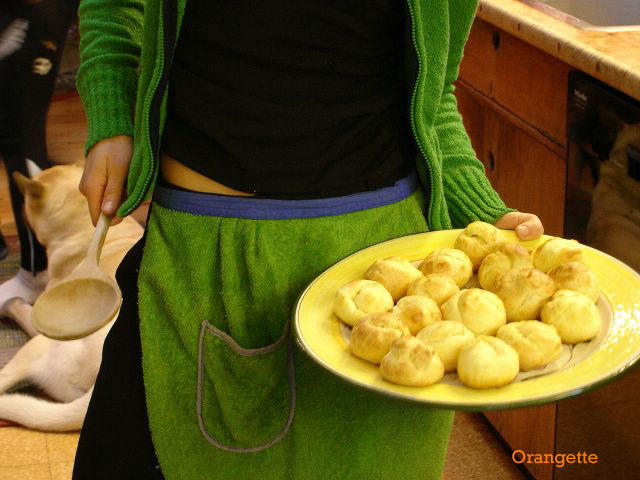
“My dowry has just increased exponentially,” Kate announced, smirking audibly into the receiver. “I made cream puffs!”


I could hear Kate's sister Margot and their mother Linda in the background, shrieking with glee. “Mom says to tell you that we’re saving the potatoes for you to do, since you’re German.”

“Polish,” I corrected.

“Yeah, yeah,” Kate laughed, “Too bad we don’t have any Polish sausages. But hurry up! We’ll see you at three.”

Another Knight family event was in the offing, and the occasion was even more momentous than last summer’s lamb roast, which is saying a lot: this time we were celebrating five years of Linda's being cancer-free. I’d been commissioned to help with the food, and I happily accepted.

I arrived in mid-afternoon to find the house awash in pink, the official color of breast cancer awareness. There were pink balloons in the foyer and vases full of pink tulips on every available surface, and pink crêpe paper was spun from the beams and light fixtures. They'd thought of everything, even making a centerpiece for the dining room table out of a bowl filled with shapely plaster breasts, leftover props from one of Margot's photo shoots. Now this would be a party.

After a brief tour of the family collection of chef’s toques,


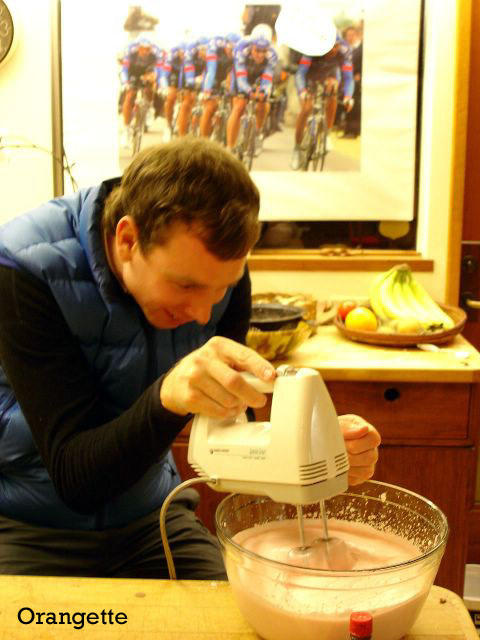
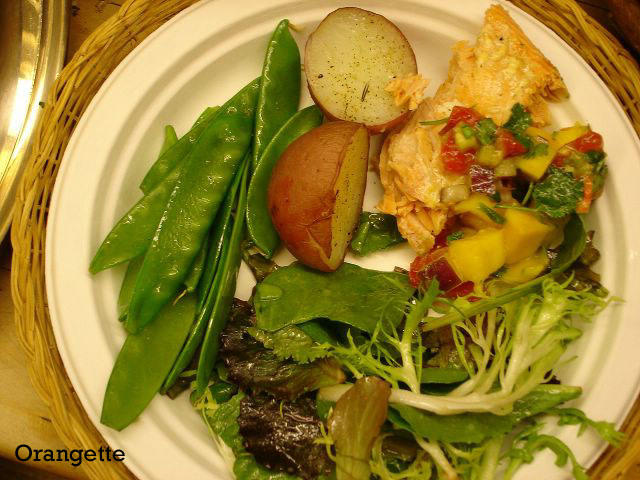
Kate set to work on another batch of choux, while I whipped up a triple recipe of my trademark vinaigrette to coat the mixed baby greens in Linda’s enormous, drum-like wooden bowl. We diced avocados, squeezed limes, and cubed mangoes for salsa, while Margot—recovering from shoulder surgery and out of commission, cooking-wise—did her part to help by eating every mango scrap we left behind, sucking on the wide, flat seeds so as not to lose a shred of the musky flesh. I parboiled new potatoes and tossed them with apple cider vinegar, olive oil, sea salt, and rosemary from the garden, and then we piled them into a wide cazuela and slid them into the oven to finish. And Margot's boyfriend Todd, showing his impressive cycling form, whipped the cream—tinted pink, of course—while riding with Lance and the U.S. Postal Service team.


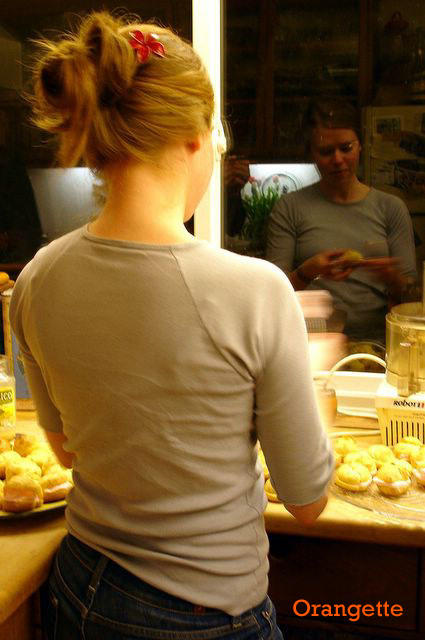
Linda disappeared into the back of the house and reemerged resplendent in a fuzzy pink sweater, black flood pants, and pink pantyhose. Kate, seeing that my outfit lacked the evening’s theme color (my dusty-purplish Peter Pan boots barely missed the mark), offered a hot-pink flower hair-clip which, she told me, had been purchased at a shop for strippers in San Francisco. Though infinitely more modest than the dining room centerpiece, the girly flower clip seemed to beg for platinum ringlets and a naughty hula get-up. I tried to do it justice.

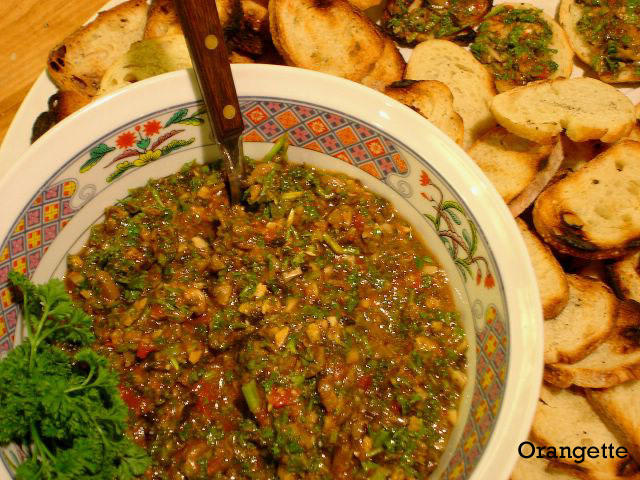
And then, before we knew it, the guests were arriving. Kate played bartender while we fielded the onslaught of flowers for Linda, among them a bouquet of baby roses tightly gathered and strategically colored to resemble a breast. The guests orbited the kitchen table and its generous spread: baked brie with honey, pecans, and sliced Granny Smith apples; plain brie with water crackers; and Linda’s delicious (but unphotogenic) bagnette with grilled bread. The undisputed hit of the evening, it was a complex and piquant mixture of diced sautéed mushrooms, parsley, tomato, red wine vinegar, olive oil, and loads of garlic.


While the guests sipped wine and talked, Todd and Kate's father Jo monitored the salmon on the grill, and Kate quickly stir-fried snow peas with olive oil, garlic, and slivers of fresh ginger. Then we gently coaxed the guests away from the hors d’oeuvres and through the buffet line on Jo's handmade wooden countertop and, plates in hand, dispersed ourselves throughout the house to eat.


And then, of course, there were the cream puffs. Dear reader,
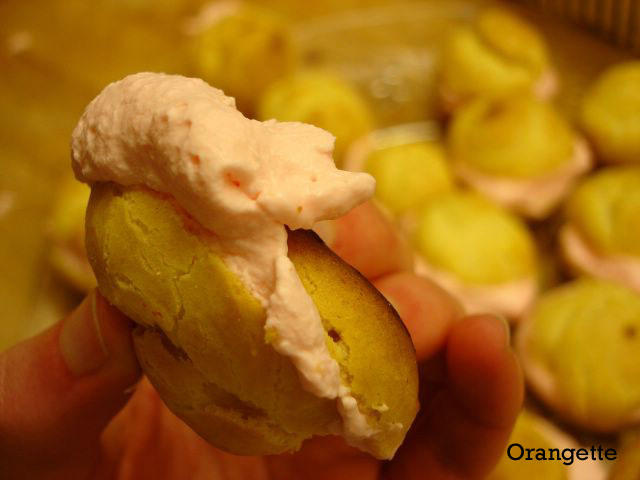
I’ve told you before that, among the Knights, everything is an excuse to eat whipped cream, but I don’t think I fully understood the depths of their dairy mania until last night. I was minding my own business, wearing that misleadingly dainty flower and scooping spoonfuls of soft pink cream into Kate’s airy, eggy-smelling puffs, when I quite nearly came to blows with Jo. Apparently, I was being too sparing with the cream, despite the fact that my finished puffs were overflowing—nay, exploding—with the stuff. I let him have his way and console himself with the whipped cream siphon and a tray of puffs, but we all knew better: mine were prettier. And anyway, with the first bite, they easily passed the ooze test. I ate three, just to make sure.


Congratulations, Linda.
I can think of no better cause for celebration*—or for eating loads of whipped cream.


*Update: Linda tells me that over the course of the evening, she collected nearly $2,000(!) in donations for the University of Washington Foundation's Breast Cancer Fund. More whipped cream, anyone?


Bagnette
From Linda Knight

This recipe, given to Linda by a friend, appears to be a variation on Italy’s bagnetto verde, which generally features garlic, parsley, and anchovies. It is wonderful as an hors d’oeuvre, spooned onto thin slices of grilled baguette, but it would also be a good accompaniment to lamb or roasted chicken.

1 bunches fresh parsley, finely chopped, plus more if needed
12-14 cloves garlic, minced
2 cans sliced mushrooms, drained (or equivalent amount of chopped, sautéed mushrooms)
½ cup olive oil
½ cup red wine vinegar
1 15-oz can tomato sauce (not tomato paste)
Salt
Pepper

Mix all ingredients together in a large bowl, and taste for seasoning. If the garlic is especially strong, add more chopped parsley. Serve at room temperature.


Red Wine-Mustard Vinaigrette
Adapted from Michael Roberts’s Parisian Home Cooking

This very simple dressing is my standard for all sorts of salads, from simple greens to shaved fennel, arugula, and Niçoise olives.

1 Tbs Dijon mustard, preferably Grey Poupon
3 Tbs good-quality red wine vinegar
½ tsp fine sea salt
5 Tbs good-quality olive oil

Combine mustard, vinegar, and salt in a small bowl, and whisk to combine. Add the oil one or two tablespoons at a time, whisking continuously to emulsify. Taste to correct vinegar-oil balance, if necessary, and toss with your favorite salad ingredients. The dressing will keep for up to two weeks in an airtight container in the refrigerator.

jueves, 10 de febrero de 2005

A man who knows meatballs

My friend Doron might lust for a more well-endowed kitchen, but he can make a mean meatball.


I should have guessed as much. After all, last summer Doron, Elizabeth, and I happened to find ourselves together in Paris for five weeks—quelle coïncidence, non?—and there was much, much meat. The man knows his stuff.

Doron and Liz were sharing a sixth-floor walk-up in the tangled heart of the Marais, and I was a mere ten-minute walk to the east, in a studio on the edge of the artsy 11th arrondissement. As luck and geography would have it, halfway between our apartments was boulevard Richard Lenoir, where each Thursday and Sunday row upon row of covered stands would magically sprout from the pavement, blossoming into the city’s largest outdoor market. From the Place de la Bastille to the Bréguet-Sabin Métro station, tables unfurled to offer crates of (cheap!) fruits and vegetables, some still splotched with dirt and smelling appealingly of damp, minerally soil. And that wasn’t all: other booths proffered neatly arranged bottles of olive and nut oils; display cases full of meat, sausages, terrines, and sauerkraut; straw mats covered with cheese in various stages of ooze; troughs mounded with nuts, dried fruits, and olives; baskets of stacked bread; and trays of hummus, halvah, or kofta.

On a previous Paris stay from 2001 to 2002, I’d managed to become a market insider, working for several months for an oil vendor called Mille et Une Huiles. Under the wise and only occasionally short-tempered tutelage of Monsieur Francis Dijos, I learned to distinguish various olive oils by nuances in their flavor: “like tomatoes on the vine,” “like artichokes,” “like freshly mown grass,” we’d chant. I also had my first taste of sweet argan oil, wooed customers with my exotic American accent, and even managed to drip some of our products down the front of my pricey and punk-chic Michael Kors coat. That market experience, however, would pale in comparison to what I’d find with Doron and Liz in July 2004. They brought me to the meat.

Each Sunday, they’d traipse over to the market around noon and collect for the week ahead: ingredients for a spinach soup, apricots for drippy afternoon binges, and bleu d’Auvergne or an aged chèvre for the daily cheese plate. And then, one fateful afternoon, there was the sopressata. The Italian specialties vendor was one of the more expensive ones in the market, and its cured meats were beyond compare: long cylinders of every diameter, rosy meat flecked with translucent white fat. The sopressata was clearly the vedette of the display, its impressively fatty cross-section bared for onlookers. Doron and Liz, ever gourmands, couldn’t resist ordering a few slices. Little did they know, the stuff must have been encrusted with gold leaf: their dozen slices would weigh in at a heart-stopping 18 euros. That Sunday would forever be remembered as the Day of Very Expensive Charcuterie. There was nothing to do but go home, open a bottle of cheap (to offset the meat expense, of course) Champagne, and feast. They would talk about that sopressata for days, their eyes glazing over in ecstasy. They were haunted. Sure, there would be other meat feasts—chopped liver with caramelized onions from nearby Chez Marianne, juicy and aromatic roasted chickens from the butcher on rue Oberkampf, or Bastille Day’s fancy terrines from La Grande Épicerie—but always, they’d moan nostalgically for that sopressata. Wanting a piece of the action, I decided to pay a visit to the Italian vendor myself, seeking preparations for a picnic shortly before my return to the States. Liz and Doron were right: the spicy, salty, deeply grassy cured meat couldn’t possibly have been improved upon—not even by the late-evening sunlight over the Place des Vosges, the soft blanket strewn with crumbs, or the wine in yogurt-jar glasses.

So I wasn’t surprised when Doron e-mailed recently from the East Coast with a tale of meatballs. “It was one of my finer moments,” he said, describing his concoction of ground turkey, cumin, cilantro, toasted pine nuts, and golden raisins. Knowing better than to take this lightly, I immediately set to work.

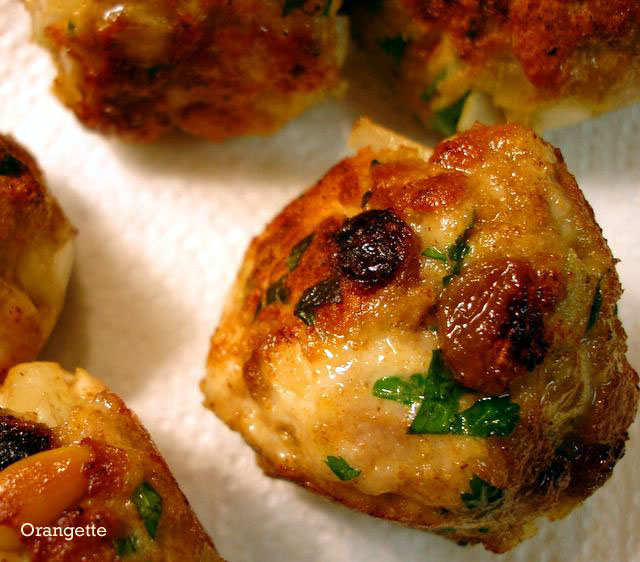
As one would expect, Doron’s meatballs are delicious—mildly spiced ground turkey brightened with the unexpected sweet-tartness of raisins and the toasty crunch of pine nuts. Dolloped with a spoonful of lemon-and-cumin yogurt sauce, they’re quite nearly moan-worthy. They’d make a great hors d’oeuvre—preferably not with cheap Champagne, although I could easily be talked into it—and they’re surprisingly good cold, an important detail for those who, like myself, often stand in front of the fridge with a fork in hand.

They’ll tide me over until I can get some more of that sopressata.


Doron’s Turkey Meatballs with Golden Raisins and Pine Nuts
Adapted from the man himself

½ pound ground white-meat turkey
½ pound ground dark-meat turkey
1 small yellow onion, minced
1 egg
¼ cup finely chopped cilantro
½ cup toasted pine nuts
½ cup golden raisins (chopped if they’re large)
½ cup fine bread crumbs
A few pinches ground cumin
½ tsp salt
A few pinches freshly ground black pepper
Olive oil
Lemon-and-cumin yogurt sauce (see below)

Mix all ingredients except olive oil and yogurt sauce together in a bowl, preferably using your hands. You don’t want to overwork the meat—that would make your final product tough—but you do want all ingredients to be evenly mixed. Form the mixture into balls of whatever size you like (mine were about 1 inch to 1 ½ inches). Heat a thin film of olive oil in a heavy skillet over moderate heat, and sauté the meatballs in batches, so as not to crowd them. As they begin to color, turn them regularly so that they are golden on all sides. They should be done when they are evenly browned and feel medium firm—but not hard—to the touch. Place on a paper towel to catch excess oil. Serve hot, warm, or cold with yogurt sauce.

Lemon-and-Cumin Yogurt Sauce

Nonfat plain yogurt
1 lemon, juiced
Garlic, finely chopped
Ground cumin
Ground chili
Salt
Pepper

Mix ingredients to taste in a bowl, and keep chilled until serving.

lunes, 7 de febrero de 2005

Eating, sleeping, breathing

This is getting serious.
Last week my friend Doron e-mailed to tell me about a dream he’d had in which he’d gone into a store and picked up “any and every kitchen tool in existence.” From microplane zesters to rubber spatulas, food processors, and stockpots, “it was heaven,” he said. I could almost hear him sigh wistfully on the other side of the computer screen.

Doron isn’t the only one who’s been eating, sleeping, and breathing all things kitchen. I’ve been known to have dreams involving roasted-onion tarts, platefuls of oatmeal chocolate-chip cookies, and butter-rich cakes stacked like gold bullion. I wake up breathless, touching my belly like a private eye looking for evidence, whispering, “Thank GOD I didn’t actually eat all that. Phew!” And coincidentally, the very same night that Doron unleashed his subconscious upon a kitchen supply store, I was dreaming of a fried chicken sandwich. In my dream, I was somewhere trying on a pair of pants, when I found myself suddenly before a deli counter of sorts. Facing me was a round, genial man in overalls. I somehow knew that the place was known for its fried chicken sandwiches, but I hesitated, unsure. The man smiled at me, gestured over his shoulder with a ruddy thumb, and drawled, “I got a whole messa chickens fried up in back. You gotta have a sanwich.” So I ordered one, and then I went back to incongruously trying on my pants, wondering whether my sandwich would come with coleslaw. Unfortunately—and as is always the case—I woke up before I could find out.

Then there are the times when all this eating, sleeping, and breathing paradoxically causes loss of sleep. Take, for example, the Sunday before last, when Kate sacrificed sleep and sanity to rise at six in the morning and bake sourdough boules before sunrise with a wifebeater and a copy of The Stranger—and this only a few days after she, in a fit of insomnia, read an entire hors d’oeuvres cookbook in the middle of night.

And of course there’s my strawberry problem, a late-night leitmotif since last June, when I giddily crammed 10+ pounds of freshly picked and washed strawberries into my freezer, blissfully unaware of the slumber they’d steal. Yes, dear reader, I’m still working my way through the berries, and I’m still lying awake at night, wondering what to do with them next. After all, before we know it, summer will be upon us again, with more fields of berries to be picked! As I said, this is serious. So thank goodness for old standbys, pinch hitters when the (alarm) clock is ticking.


Gâteau au Yaourt à la Fraise, or French-Style Yogurt Cake with Strawberries
Adapted from Gâteaux de Mamie


This cake is another slight variation on the yogurt cake I wrote about last August, a fantastically easy one-bowl French invention. Strawberries will be woefully out of season for another few months, but take heart: this recipe works beautifully with frozen fruit. The cake rises tall in the pan, and the strawberries collapse onto themselves, leaving moist, jammy pockets. The result has a light, moist, not-too-sweet crumb—perfect with coffee in late afternoon or with a melty scoop of ice cream after dinner. It tastes like June, like things to come.

Note: If you don't have a little individual-size yogurt jar from France—and we can't all have them—know that 1 jar equals 125 ml, or a touch over 1/2 cup.

1 jar plain yogurt (I like Brown Cow brand, either Cream Top or nonfat)
2 jars sugar (I like to use raw cane sugar, or a mixture of white and brown sugars)
3 eggs
2 jars unbleached all-purpose flour
1 jar finely ground blanched almonds (a Cuisinart does a fine job, but be careful not to turn your almonds into almond butter; you're aiming for a powdery texture)
2 tsp baking powder
1 jar canola oil
Frozen (quartered or halved, depending on their size) strawberries

Preheat the oven to 350 degrees Fahrenheit. Grease an 8-inch round cake pan with butter or cooking spray.

In a large bowl, combine the yogurt, sugar, and eggs, stirring until well blended. Add the flour, ground almonds, and baking powder, mixing just to combine. Add the oil, stirring to incorporate. Pour about 2/3 of the batter into the prepared pan, and distribute frozen strawberries—about two handfuls—evenly over the batter. Pour the remaining batter over the berries, trying to cover them as well as possible.

Bake for 40-50 minutes, until the cake feels springy to the touch and a toothpick or cake tester inserted into the center comes out clean. [Because you’ve put frozen fruit into the cake, it may take a bit longer, depending on your oven. If, after thirty or so minutes, the cake is browning too quickly, you may need to tent it with foil.]

Cool cake on a rack for about 20 minutes; then turn it out of the pan to cool completely. Cut into wedges and eat with satisfaction, watching your freezer slowly empty.

An interlude, or what I listen to when eating orangettes

It’s been making the rounds, and thanks to fellow Seattlite Megan of iheartbacon, it’s come to Orangette: the “music in my kitchen” survey. I’m generally not one for these sorts of things, but I’ll make an exception this time, since a) nobody likes a party pooper, and b) music accompanies nearly every moment of my waking life—and especially my time in the kitchen (which, in my experience, easily doubles as a dance floor with a very convenient refreshments stand). So, with no further ado:

Q: What’s the total size of music files on your computer?
A: Zero. I’m still very loyal to the CD. I like my music to be tangible, for now.

Q: What is the last CD you bought?
A: There are two: Bill Frisell’s Unspeakable and Ted Leo and the Pharmacists’ Shake the Sheets, both gleefully purchased with the aid of a gift card from my grandmother. [Nanzer is forever trying to buy clothing for me at Christmas, which is a very, very bad idea. She just won’t let up, despite ominous but good-natured warnings from both me and my mother. But this past Christmas, the heavens opened and a new era dawned: while I did get the requisite piece of clothing or two, she also gave me a gift card to one of those big bookstore chains. It's a start!] Thank you, Nanz.

Q: What is the last song you listened to before you were tagged to do this quiz?
A: I was driving a rental car, and I’d turned on the local easy-listening station, since that’s the sort of thing you’re supposed to listen to in rental cars. So, as luck would have it, the last song I listened to was Elton John’s “Tiny Dancer,” which, at the suggestion of one of my cousins, I prefer to call “Hold Me Closer, Tony Danza.”

Q: Name four songs that you listen to a lot or that mean a lot to you.
A: I’m going to list both, because I can.

Songs that I listen to often (read: must be invigorating and at least somewhat danceable):
1. Ted Leo and the Pharmacists’ “Shake the Sheets” (put on your boots and dance, I say)
2. Q and Not U’s “When the Lines Go Down” (very infectious, slightly spastic beat)
3. Les Savy Fav’s “Yawn. Yawn, Yawn
4. Femi Kuti’s “Do Your Best” (those horns! that Mos Def! tasty with breakfast!)

Songs that mean a lot to me (read: songs that give me goosebumps):
1. Radiohead’s “Where I End and You Begin”(sexy, moody, lonely, and slightly creepy, with a great beat)
2. Mano Solo’s “Les Gitans” (that heartbreaking voice, that piano! Je me laisse transporter…)
3. Plácido Domingo and John Denver’s “Perhaps Love” (John Denver’s voice is so crystal-clear, so reassuring; this song is my dad, my childhood, and our old house on Westchester Drive)
4. David Byrne’s “The Great Intoxication” (fantastic drum opening, strings, and outstanding Major Genius Mr. Byrne lyrics; this song is falling in love itself)

And now, back to the meat of the deal…

miércoles, 2 de febrero de 2005

On Spandex, a mother’s genius, and whole wheat bread

Sometime in the early 1980s, my mother discovered exercise.

First there was aerobics, with its perky wardrobe of pastel tights and leotards with matching elastic belts, legwarmers, and sweatbands. For many of my formative years, I quite nearly lived at the Workout, an aerobics studio in northwest Oklahoma City. Mom would suit up in her Spandex; pack a bag of books, markers, and Pepperidge Farm Goldfish to keep me busy; and off we’d go. For those who wonder about the origins of my uncanny ability to remember song lyrics of the period, look no further: I owe it all to the Workout and countless hours spent listening to Whitney Houston, the Pointer Sisters, and the thud of Reeboks reverberating off the studio mirrors.

As one might expect, my mother turned out to be quite a natural, and it wasn’t long before we were friendly with all the instructors—part of the gang, if you will. I developed a preschool “crush” on the prettiest, nicest one and decided that I wanted to change my name to Sherry in her honor. Luckily, however, that did not come to pass, and so the most lasting element of the aerobics years would turn out to be my mother’s fifteen minutes of fame: an appearance on the local morning television show hosted by brothers Butch and Ben McCain,* where Mom and the Workout instructors did an aerobics demonstration in their shimmery tights.

But not long after reaching such heights, Mom was converted to weight training, an endeavor that lacked music, special outfits, and therefore basic appeal, at least to my way of thinking. Mom, however, charged on, scoring impressive biceps and pects for her petite 5’¾” frame. Weight training then led her into the personal-training craze of the early 90s, and before I knew it, Mom was a certified trainer herself, driving to meet clients all over town with Dynabands and Pearl, a giant iridescent rubber ball, in her backseat. Then, several years ago, she morphed into her latest incarnation, a certified Pilates instructor with her own very chic studio, and it looks as though this is where she’ll stay.

But my mother’s two-plus decades of fitness genius have brought me more than a near name-change, mad ‘80s karaoke skills, and a pricey devotion to Pilates. They’ve also brought me Rancho La Puerta, and, even more importantly, fantastic whole wheat bread.


When I was eight or so, Mom was introduced by an old friend to “the Ranch,” a fitness spa in humble Tecate, Mexico. I went with her on her first visit, sneaking in an emergency stash of Oreos, Nestle Quik, and sugared cereal, junk food I’d never be allowed at home but that somehow seemed necessary for a pre-pre-teen at a borderline-hippie vegetarian health spa. I tried to join in on a few aerobics classes, bouncing on my gangly legs and hiding in the back row, but suffice it to say that I was unenthused. It would be nearly a decade before Mom would take me with her again, for a spring break trip during my junior year of high school.

This time, I knew a good thing when I saw it, and for the four or five years that followed, the Ranch was our annual springtime extravagance. From early-morning hikes in the meadow, watching lizards and rabbits scamper under the tall dewy grass, to breakfasts of hearty toasted Ranch bread and pear butter, afternoon Pilates classes, and naps in shaded hammocks, I soaked it up. Nearly every night we treated ourselves to pre-dinner massages that would leave us warm, greasy, and hungry, and we’d always ask for seconds of dessert—that is, when we weren’t lying about my date of birth in order to get dense and delicious Ranch-style whole wheat birthday cakes with tofu icing. Sometimes there were nighttime workshops (“Dance with Yuichi!”) or bingo (Ranch granola for winners!), but Mom and I only rallied on special occasions, such as when Beverly Whipple, fellow guest, noted sexologist, and straight-talker, gave a workshop on “Sexuality: Yours, Mine, and Ours.” Though some things are best experienced without one’s parents (or children), Mom and I put on poker faces, talked erogenous zones, and even partnered on the hand-caressing exercise ole Bev ordered up. And then, as with every other night, we walked through the quiet, cold air to our tile-floored hacienda and collapsed into our beds, spread with Mexican yellows and pinks. A genius indeed, that mother of mine.

Unfortunately, and for a host of reasons, our Ranch years seem to have gone the way of aerobics. Among today's list of necessary extravagances, a fitness spa doesn't take top billing. But that’s alright, because after all, there were those pesky wild dogs that would howl outside our little villa at night, and by the end of a few days of high-minded virtuousness, I was pretty cranky for a mouthful—or ten—of chocolate. And anyway, I can wake up in my own quiet bed, look out over the dewy trash in the street, watch cars scamper across the parking lot, and eat my toasted Ranch bread, any day, all right here in Seattle.


* For a real treat, click on the “Music” link and scroll down to the heartwarming photo of Butch and Ben with Buck and Roy of HeeHaw. Now, that’s fame.


Rancho La Puerta Whole Wheat Bread
Adapted from The Rancho La Puerta Cookbook: 175 Bold Vegetarian Recipes from America’s Premier Fitness Spa, with thanks to jolly Bill Wavrin

At the Ranch, this simple, dense bread is served toasted at breakfast and, still warm from the oven, in baskets on each table at dinner. You’ll note that the original recipe calls for no salt(!), a purposeful omission that makes for a wonderfully clean, healthy-tasting bread. I’ve grown to like it that way, but you can easily make a more fully-flavored, "normal" version by adding up to 2 teaspoons of fine sea salt when you mix in the flour.

¼ cup honey
2 Tbs (2 packages) active dry yeast
2 Tbs canola oil
6 ½ cups whole wheat flour, plus more as needed
2 tsp salt

In a mixing bowl, combine 3 ½ cups tepid water, the honey, yeast, and oil. Stir and set aside for 5 or 6 minutes, until mixture bubbles and foams. In the meantime, spray two 8- by 5-inch loaf pans with cooking spray.

Add the flour, a cup or so at a time, and the optional salt, mixing with your hands or a wooden spoon until the dough comes together and forms a manageable ball. Turn out onto a lightly floured surface and knead for 8 to 10 minutes, until your hands come clean when lifted from the dough and the dough is smooth and elastic. [To test if the dough is well kneaded, insert a clean thumb into the dough, and count to 5. If your thumb comes out clean, the dough is kneaded properly, and you don’t need to add any more flour.]

Preheat oven to 350 degrees Fahrenheit. Divide the dough into two equal-sized pieces, and shape into loaves. Place loaves in pans. Cover with dish towels, and set aside in a warm, draft-free place for 40 minutes to 1 hour, until doubled in bulk.

Bake bread on the center rack of the oven for about 40 minutes, until the crusts are golden brown and the loaves sound hollow when thumped on the bottom. Cool completely on wire racks before slicing.

Yield: 2 loaves