lunes, 12 de junio de 2006

The fourth color in the rainbow

The most depressing meal of my life was white and yellow. That’s all I remember. As someone who spends her free waking hours trying to capture in words the look, taste, and texture of her food, I find this a little embarrassing. It tasted pale, and that’s the most I can say. Maybe it involved sticky rice and a crookneck squash, or a pallid filet of plain, white-fleshed fish. Maybe it was a stir-fry constructed on the color palette of a daisy. Evidently, its details were not memorable, nor delicious. It was nearly nine years ago, a dinner in the dining hall of my freshman dormitory, and I guess that alone should tell me something. But still, all I remember is the white and the yellow, pale and pasty, and the sour taste of my disappointment as I stared at it, still hungry. And maybe that’s for the best.

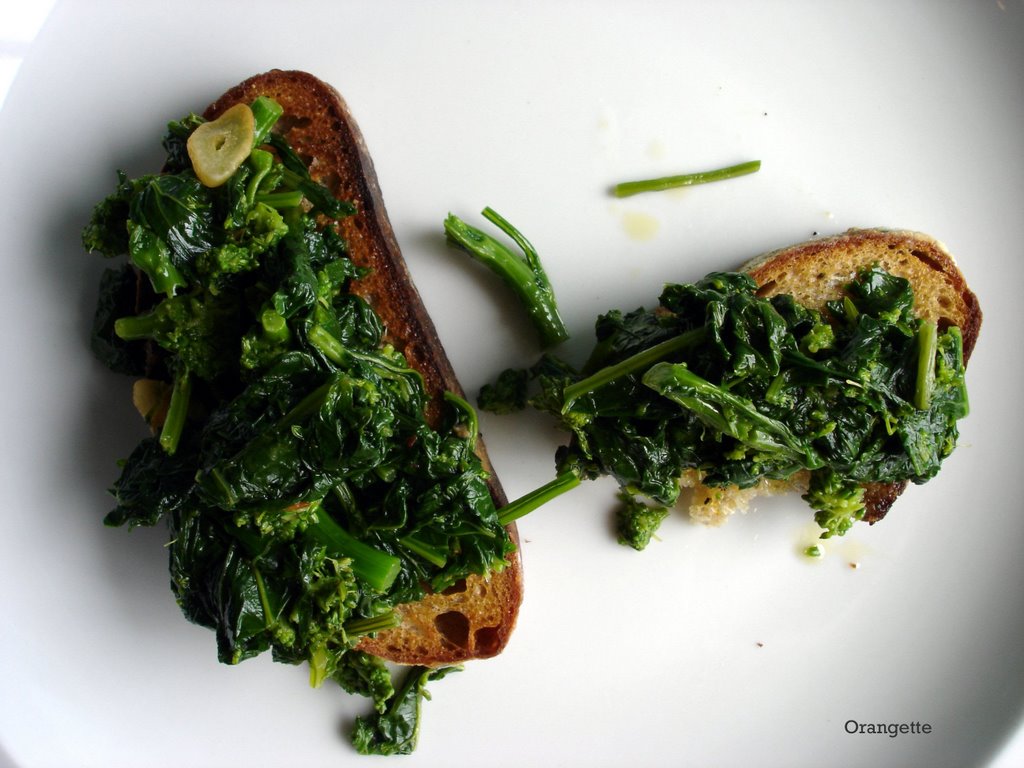
I’m certainly not the first person to trot out the old we-eat-with-our-eyes adage, and anyway, I’m not always sure that it’s true. But on days like today, I really do think that it’s all in the color. Or that’s what I said to myself when I sat down to a plate of broccoli rabe, cooked just to tender and a shiny emerald green, piled atop two pieces of garlic toast.

Even up here in the Pacific Northwest, where real summer is still on its way, the browns and oranges and dingy whites of winter are giving way to a whole spectrum of pinks, peaches, reds, and greens. I may be the only person out there inclined toward color-coded food cravings, but I swear, sometimes a body just wants something green. This has nothing to do with nutritional value, or at least, not on the surface. This is not about diets, bikinis, or Shape magazine. This is about the shape and flavor of the fourth color in the rainbow: grassy, earthy, and herbal.
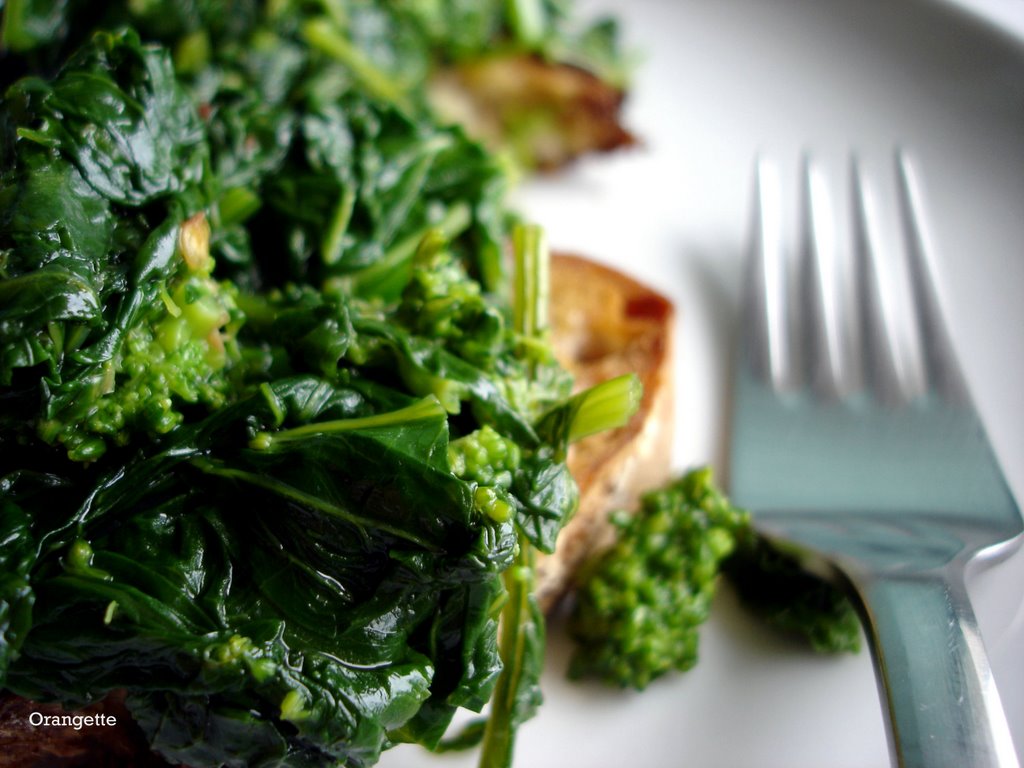


This is about a green that’s sweet and garlicky with an aftertaste of heat, heaped into a tangled topknot on a slice of toast. Broccoli rabe is not a summer vegetable, per se, but there was a pretty bunch in the market this weekend, and well, I had a craving. It’s a funny, hybrid-looking thing, with a wild look that sits somewhere between broccoli floret and shiso leaf. But once blanched and sautéed with lots of olive oil and garlic, it tames to a delicious, pungent, and lightly bitter flavor, not entirely unlike Swiss chard or kale. Drippy with olive oil and its own cooking juices, it calls for a plate under the chin and a napkin in hand. And it tastes of nothing but green—which is to say, not pale, and certainly not depressing.


Broccoli Rabe Toasts with Olive Oil, Garlic, and Red Pepper
Adapted from Gourmet, April 2006

This is one of those lots-of-bang-for-your-buck numbers. If you have even a bachelor pad pantry, you’re most of the way there: just buy a bunch of broccoli rabe, put a pot of water on to boil, and all you have to worry about is your impending garlic breath. This Italian-flavored recipe can feed two to four people, depending on portion sizes and the number of bread slices you choose to use. I made a light lunch—with leftovers for tomorrow—out of two heaping toasts, a grapefruit, and some chocolate, but more greens-wary souls might prefer a smaller serving as a starter, or served alongside a meaty main course.

For the toasts:
A few slices, about 1/3 inch thick, from a long, crusty, country loaf
Olive oil
Salt
Pepper
1 garlic clove, halved crosswise

For the broccoli rabe:
1 lb broccoli rabe, large stems discarded and the remainder coarsely chopped
3 Tbs good-quality olive oil
2 large garlic cloves, sliced
1/8 tsp dried red pepper flakes
3 Tbs water
¼ tsp salt

Preheat the broiler, and fill a large saucepan or Dutch oven about 2/3rds full of salted water. Bring it to a boil over high heat.

While the water is heating, prepare the toasts. Place the slices of bread on a baking sheet, brush both sides of the bread with oil, and season them lightly with salt and pepper. Broil the bread about 4 inches from the heating element, turning the slices halfway through, until golden, about 3 minutes total. Gently rub both sides of the bread with the garlic. Discard the garlic, and set the toasts aside.

When the water comes to a boil, add the broccoli rabe, and cook, uncovered, until tender, about 4 to 5 minutes. Drain the broccoli rabe into a colander, and press it gently to remove any excess water. Set it aside.

Wipe the pot clean, add the oil, and warm it over medium heat. Add the sliced garlic and red pepper flakes, and cook, stirring occasionally, until the garlic is golden, about 2 minutes. Taking care to avoid hot oil splatters, add the broccoli rabe, water, and salt, and cook, covered, stirring occasionally, about 2 minutes.

Divide the warm broccoli rabe over the toasts, and serve.

Yield: 2 to 4, depending on the number of toasts and the appetites around the table

lunes, 5 de junio de 2006

I do, deviled eggs

I’ve been mum lately, I know, on the whole marriage thing. I stirred up a ruckus, and then I went silent. But you should know that I haven’t changed my mind, and that most of the time, my feet aren’t cold. I won’t be picking up my petticoat and fleeing for the hills with my maiden name still intact. What’s been keeping me quiet is something much more predictable: I’ve been planning.

Since the afternoon of our engagement, when we strolled Brooklyn in the late sun, squinting at the strange new ray of light from my ring finger, we’ve been planning what I call a big party with a ceremony on the side. We knew that we wanted a summertime setting, but seeing as it was already late March, that made timing a little tricky. We didn’t want to rush. We wanted time to play with the details and, most importantly, to enjoy each other in the process. We’re also picky, and being picky is most pleasant, I find, when you’re not in a hurry.

So with all that in mind, and with historical weather data on our side, we have set a date and, so far, a few key details. We will be married on July 29, 2007, in a smallish town outside of Seattle, on the coast. Our ceremony will take place in a park by the water, with dinner a short walk away. I will come down the aisle on my mother’s arm, swathed in twenty strapless yards of Chantilly lace. And then there will be deviled eggs.


I love deviled eggs. They may be a stale stowaway from the 1950s and the ugly stepchild of every family barbeque, but damn it, I do not care. When properly made, there is no two-bite package more perfectly suited to a summer day than a cool hard-boiled egg white with a creamy filling. If you feel any degree of fondness for egg salad, it’s pure hypocrisy to diss the deviled egg. Rich with mayonnaise, tangy with mustard, and with a spicy, tingly edge, it’s the lowly egg’s best shot at becoming something fancy—America’s answer, I suppose you could say, to the French soufflé.

And these days, that something fancy can be pretty fancy indeed, with toppings that go beyond the usual dusting of musty paprika. A deviled egg with caviar is a nice surprise, or smoked salmon or a little bit of curry. I’ve even seen them breakfast-style, with shards of bacon and fine, crispy breadcrumbs. What style we’ll serve at the wedding is still to be determined—and we do, phew, have fourteen months to decide—but what I made this weekend was awfully nice.


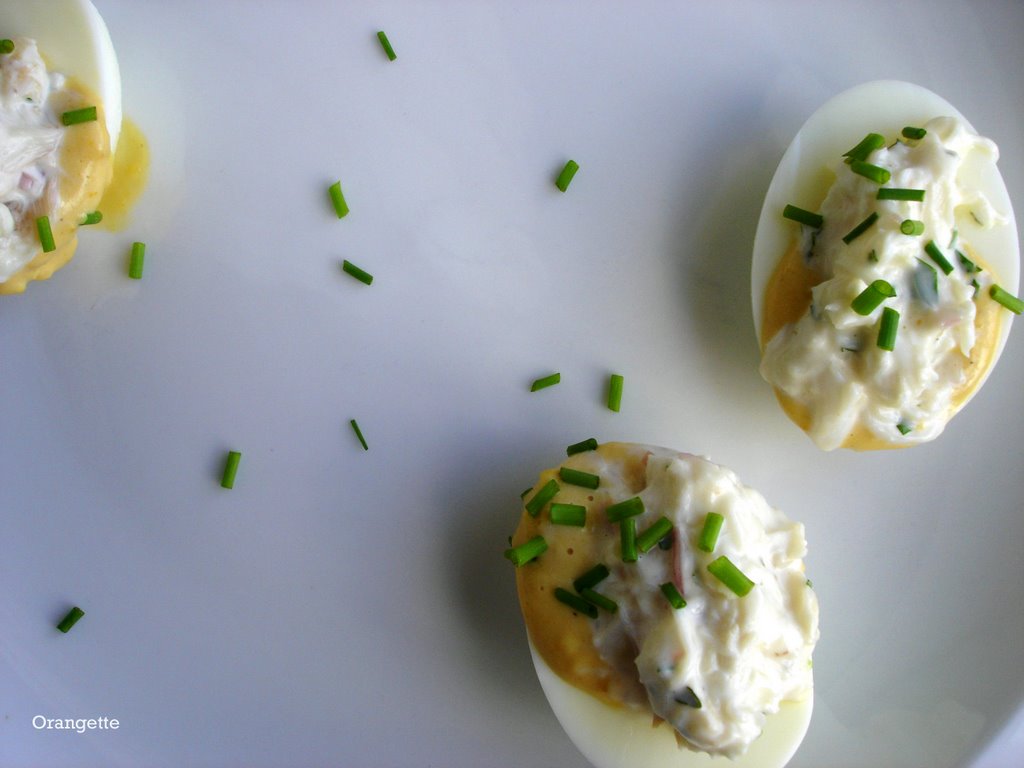
A messy union of Americana and classic French cuisine, this deviled egg is fitted with a saucy hat of crabmeat ravigote, a cold sauce with—depending on who you ask—a mayonnaise or vinaigrette base flavored with fresh herbs. The sweet, mild flavors of crabmeat and egg are a natural pair already, but combine them in a cloud of mayonnaise shot through with summer herbs, and you’ve got something worth planning for—even fourteen months ahead.


Deviled Eggs with Crabmeat Ravigote
Adapted from Jeff Tunks and Chris Clime of Acadiana

I first tasted a version of these eggs at Washington, D.C.’s Acadiana, a “contemporary interpretation of a Louisiana fish house” that happens—full disclosure!—to be co-owned by one of my brothers. I may be biased, but I think these are uncannily good deviled eggs. If you should someday happen to find yourself near our nation’s capitol, go to Acadiana and order the trio of deviled eggs—but until then, make them yourself.

My first attempt at adapting the recipe yielded a deviled filling that was a tad too loose, as evidenced in the photographs above. I have adjusted the quantities below for what I hope will be a slightly more firm filling. Be sure to use good mayonnaise—preferably homemade—and buy the freshest crab possible.

4 large eggs
1 Tbs Dijon mustard
1 tsp Tabasco sauce
1 tsp Worchestershire sauce
6 Tbs good-quality mayonnaise, divided
Salt
Pepper
2 ounces fresh lump crabmeat, such as Dungeness
1 tsp diced shallot
½ tsp minced garlic
½ tsp minced fresh thyme
½ tsp minced fresh Italian parsley
1 tsp apple cider vinegar
Finely chopped chives, for garnish

Fill a medium saucepan with water, and bring it to a boil. Place the eggs in the boiling water, and cook them for 10 minutes. Remove the pan from the heat, pour out the boiling water, and immediately run cold water over the eggs to cool them and stop the cooking process. When the eggs are cool, carefully peel them, and slice them in half lengthwise. Gently remove the yolks, and place them in a small mixing bowl. Set the whites aside.

Using a fork, mash the yolks well. Add the Dijon mustard, Tabasco sauce, Worchestershire sauce, 3 Tbs of the mayonnaise, and a pinch or two of salt. Whisk the mixture until it is creamy. Taste for seasoning, and adjust as necessary. Carefully spoon or pipe the yolk mixture back into the egg white halves.

In another small bowl, gently stir together the crabmeat, shallot, garlic, thyme, parsley, vinegar, and the remaining 3 Tbs of mayonnaise. Mix well. Divide the crabmeat mixture among the egg halves, and garnish with chives. Serve immediately.

Yield: 8 deviled eggs

martes, 30 de mayo de 2006

Second time's a cupcake

If there’s one flavor that I hate, it’s the aftertaste of failure. Call me a perfectionist or a spoiled little snot: either is an apt description. When something doesn’t go my way, I sulk. I’m a master of the silent treatment. I can pout so hard that my lower lip sticks out a full inch. Worst of all, when said failure involves a chocolate malted cupcake, I’ve been known to air my dirty disappointment in the most public of places: on the Internet, sneakily disguised as a bowl of lima beans. Maybe it would be smarter to take up yoga or meditation, or to sign myself up for anger management classes, and maybe I will. Or maybe I’ll just bake more cupcakes.

As the old saying goes, if at first you don’t succeed, try, try another recipe.


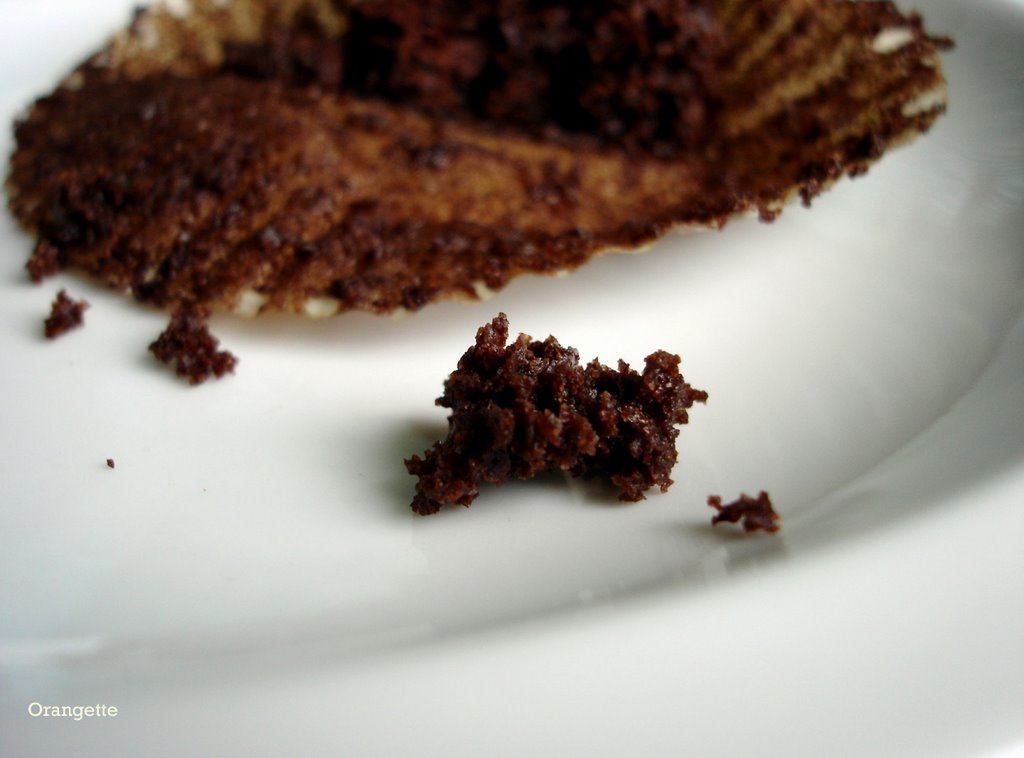
My first—and failed—attempt came from the pages of Nigella Lawson’s Feast, but feast, I’m afraid, it was not. I dutifully followed her recipe for a “Chocolate Malteser Cake,” but the resulting offense tasted neither of chocolate nor of malt, and its crumb was a mousy brown, dull and rubbery. Before the cupcakes so much as saw my icing spatula, they were rerouted to the trashcan. Given my previous statements about Ms. Lawson—we’re no longer on a first-name basis—you can well understand my need to sulk.

But because I still wanted dessert, I began to slowly prepare myself for a second go-round. I did a little research, thumbed through a cookbook or two, and then I took down the trusty accordion file of recipes that sits atop my refrigerator. To start anew, I figured, sometimes a girl must retreat to familiar territory, so I pulled out an old, tried-and-true recipe for chocolate cake, and I tried, tried again.

The cupcake itself, I decided, didn’t need to contain malt; what I wanted was a good, stand-alone chocolate cake, something that needs no adornment. In the same way that a good ice cream sets the tone for a milkshake, this cake would be a solid base on which to build my malted flavor. From there, I could fuss with the frosting until I had something creamy, toasty, and tinted with cocoa, a flavor that tasted as though it could be slurped through a straw. And that, dear reader, is success for you.


With two types of chocolate and a half-cup of buttermilk, these cakes bake up to a pretty shade of brunette, with a rich, tender crumb that shines under the light. Capped with a lazy swirl of soft, malted frosting, it’s like a milkshake, but with a more satisfying chew.


Chocolate Malted Cupcakes
Adapted from Epicurious and Nigella Lawson’s Feast

This cake recipe is very delicious and very, very delicate. Its tender crumb makes it one of the best cakes I know of, but it’s almost too fragile for a cupcake. Plan to eat these with a plate nearby, and with a napkin to erase the evidence.

For cupcakes:
1 ounce good-quality semisweet chocolate, finely chopped
½ cup hot brewed coffee
1 cup granulated sugar
¾ cup plus 1 Tbs unbleached all-purpose flour
½ cup unsweetened cocoa powder (not Dutch process)
Generous ½ tsp baking soda
¼ tsp baking powder
Scant ½ tsp salt
1 large egg
¼ cup canola oil
½ cup buttermilk
¼ tsp pure vanilla extract

For frosting:
2 cups powdered sugar
1 Tbs unsweetened cocoa powder (not Dutch process)
1/3 cup malted milk powder, such as Carnation or Horlicks
9 Tbs (1 stick plus 1 Tbs) unsalted butter, at room temperature
2 Tbs boiling water


Preheat the oven to 300 degrees Fahrenheit. Line 12 cups of a muffin tin with paper liners.

Place the chocolate in a medium bowl with the hot coffee. Let stand, stirring occasionally, until the chocolate is melted and the mixture is smooth and opaque.

In another medium bowl, combine the sugar, flour, cocoa powder, baking soda, baking powder, and salt, and whisk to combine well.

In a large bowl, beat the egg with an electric mixer until it is pale yellow in color, about a minute or two. Slowly add the oil, buttermilk, and vanilla extract, beating to combine well. Slowly add the melted chocolate mixture, and beat to thoroughly combine. Add the dry ingredients, and beat on medium speed until the batter is just combined. Using a rubber spatula, scrape the sides of the bowl and briefly fold the batter to be certain that all of the dry ingredients are incorporated.

Divide the batter evenly among the 12 prepared muffin cups. Bake for 20-25 minutes, or until a toothpick inserted in the center of a cupcake comes out clean. Cool the cupcakes for 15 minutes in the pan; then gently transfer them to a rack to cool completely. They are very delicate and tender, so take care.

When the cupcakes are cool, make the frosting. In the bowl of a food processor, combine the powdered sugar, cocoa, and malted milk powder, and process to mix well. Add the butter, and process to blend. Stop the motor, and scrape down the sides of the bowl with a rubber spatula. Then, with the motor running, add the water. Process briefly, until the frosting is smooth. Frost the cupcakes in loose swirls, and serve.

Yield: 12 cupcakes

martes, 23 de mayo de 2006

Lima beans, long overdue

I know, I know. I keep you waiting for a whole week, and then I arrive with nothing to show for myself but a bowl of lima beans and a mouthful of garlic breath. As my mother would say, “Hmph! She’s got a lot of nerve.” Well, yeah, I guess I do.


But if it makes you feel any better about our relationship, dear reader, know that I had planned to bring you cupcakes instead—and awfully good ones, at that. I was aiming to recreate in cake form the chocolate malted milkshakes of my childhood, the kind that I slurped through pink-and-white striped straws at Braum’s Ice Cream and Dairy Stores throughout the state of Oklahoma. Sadly, though, the cupcakes and I had a run-in when they decided to turn into something with the texture of a kitchen sponge, and when they tasted more like a cheap, too-sweet, boxed cake than a chewable incarnation of my beloved chocolate malt. It was a hard weekend, to say the least, and in the end, the best part was finding, in a fit of desperation, a package of baby lima beans in the back of the freezer.

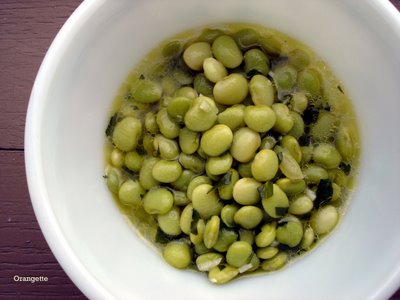
Now, I know that the words “lima beans” are not, for most people, synonymous with “delicious.” A lima bean is nobody’s chocolate malt. But I have long loved its mild, green flavor and its soft, starchy creaminess, and I should have written about this dish a long time ago.


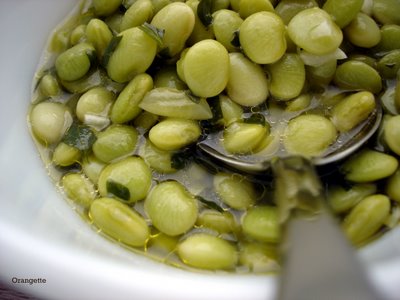
I stumbled upon this recipe almost three years ago now, in an old issue of Gourmet. It quickly became a standby, calling, as it does, for only a few basic ingredients: a pack of baby limas, a glug of olive oil, a handful of parsley, and an unflinching dose of garlic, plus a little water and salt to hold it all together. I could eat these lima beans like candy, by the handful. I go after them first with my fork, and then I follow with hunks of coarse, crusty bread to sop up the sweet, oil-dotted broth. It may be a modest dish in appearance and name, but under a sheen of grassy olive oil and a pungent cloud of garlic, these lima beans taste better, I think, than most cupcakes. Or mediocre chocolate malt ones, at least.


Greek-Style Lima Beans
Adapted from Gourmet, November 2003

Although this recipe was originally published in early months of winter, it tastes like spring to me. Conveniently, it is also a perfect receptacle for the Italian parsley left over from a batch of poached halibut. You could also try this method with fava beans rather than limas, I’ll bet, if you’re feeling especially bold and brazen. Whatever you do, be sure to serve this with plenty of good, crusty bread: you won’t want to lose a drop of the broth.

1 (10 oz.) package frozen baby lima beans
1 cup water
2 Tbs good-quality olive oil, plus more for serving, if you like
2 Tbs coarsely chopped fresh Italian parsley
1 Tbs minced garlic
½ tsp salt

In a medium heavy saucepan, combine the lima beans, water, olive oil, parsley, garlic, and salt. Place the pan over medium heat, and cook, covered but stirring occasionally, until the beans are tender, about 15-20 minutes.

Transfer to a serving bowl, and serve, drizzled with more olive oil, if you like.

Yield: About 4 side servings

lunes, 15 de mayo de 2006

How I feel about brunch

I’m not sure how to feel about brunch. In my book, it’s really sort of a tease. It’s the meal that I most salivate for, a holy union of sweets and savories, a weekly wonder spot where pancakes, crêpes, toast, eggs, hash browns, sausages, scones, waffles, and maple syrup converge. I entertain grand fantasies of Sunday mornings out somewhere, with plates of pancakes and Brandon nearby, whiling away our bleary eyes over freshly squeezed orange juice. But more often than not, brunch just leaves me sorry, with a heavy stomach and the sour aftertaste of regret. It’s the one-night stand of meals, you could say—the sort of one-night stand that you might experience on a weekend morning, of course, and in broad daylight, with your betrothed.

This feeling has been sneaking up on me for a while now, but it wasn’t until a month or so ago that I was ready to admit it. It was a Sunday morning, and Brandon and I had just come from a brunch of eggs Benedict at Glo’s with Rebecca and Jimmy. It was a clear, crisp April day, the sort of weather that makes my engagement ring really sit up and sparkle. I had my man by my side and an easy day ahead, and I’d just eaten a toasted English muffin topped with two perfectly poached eggs and the most delicate, lemony hollandaise to ever meet my fork. But I had also, unfortunately, fallen prey to the piece of communal coffee cake that landed in the center of our table, as well as a pile of greasy hash browns that happened to be on my plate.

These things can happen, as you know, and especially at brunch. Whether you’re inclined to the sweet or the savory, in the end, the entire menu looks delicious—and it is, sort of, under its snowdrift of whipped butter or its slow-running river of cheese. Inevitably, I wind up wishing that brunch came later in the day—at dinnertime, maybe—when my stomach and psyche are better prepared for such things. Even if I manage to restrain myself to something sensible—say, a bowl of oatmeal—I’m really no safer: it emerges from the kitchen nearly eight times larger than anything I would fix at home. And usually, that’s where I wish I had stayed.


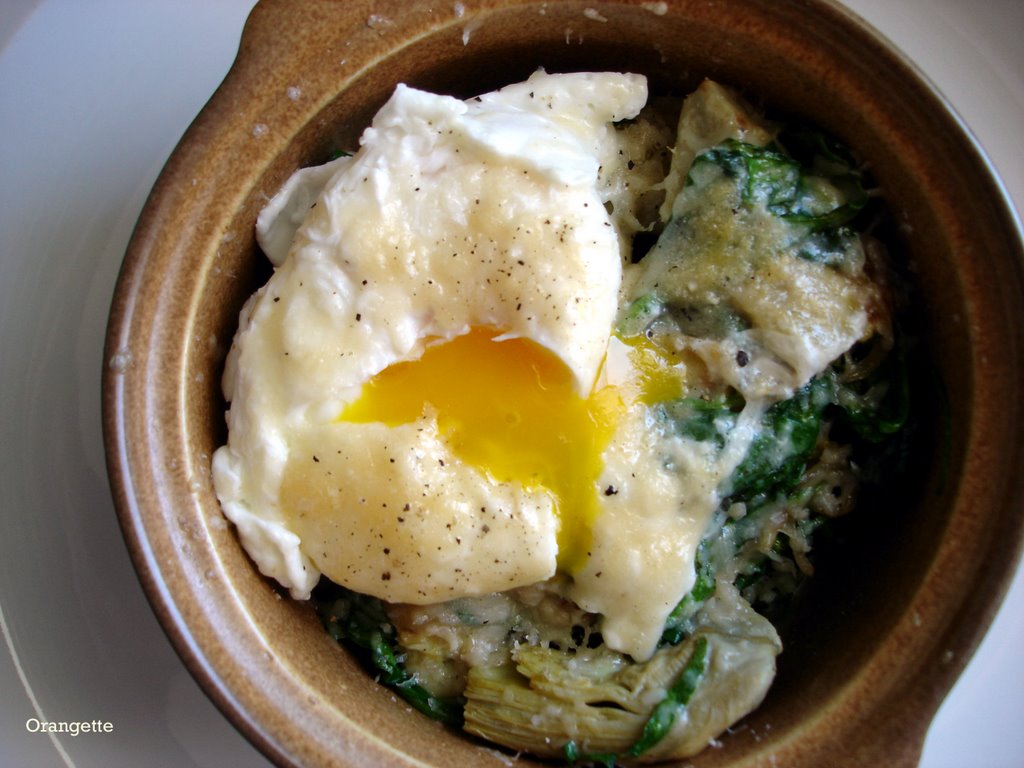
Luckily, I have found a brunch partner who shares my sentiment, and who is happy to have his orange juice in the do-it-yourself comfort of a home kitchen. He also, incidentally, makes a mean eggs Florentine, a less frilly riff on the classic layered dish of eggs, spinach, and white sauce spiked with cheese. Brandon’s version is based on one he once ate at Balthazar, with an artichoke heart as a base. To keep things as simple as possible—as they should be, I think, on a Sunday morning—he does away with the white sauce and instead treats the vegetables to a quick sauté in sweet butter. Its rich, familiar flavor elevates what might otherwise be just a plain pile of artichoke and greens, making for a dish that is lighter and cleaner-tasting than its namesake, but still worthy of a weekend morning.


In fact, with a poached egg on top and a shower of Parmigiano-Reggiano, it’s even worthy of repetition, weekend after weekend. I made it yesterday—sans Brandon—for my mother, who had come to Seattle for 48 hours of early-stage wedding scouting, and if I read her face correctly, I dare say that my betrothed has her blessing. But he knew that already.


Eggs Florentine with Artichoke Hearts, à la Brandon
Inspired by Balthazar

On first glance, the centerpiece of this dish is the timeless duo of eggs and spinach. But to my palate, the crux of the matter is the butter. This recipe does not involve a large quantity of the stuff, but its aroma and flavor infuse the spinach and artichokes, stretching into every bite. Between that and the runny poached egg, a fairly straightforward combination of ingredients becomes something deeply satisfying. And, as Brandon likes to say, “It doesn’t make you want to die afterwards.” It would also be delicious for lunch or dinner.

A scant 2 Tbsp. unsalted butter, divided
1 (8 oz.) package frozen artichoke hearts, thawed overnight in the refrigerator, or 8 oz. fresh artichoke hearts, trimmed and blanched
1 medium shallot, peeled, halved, and thinly sliced
A generous ¼ pound baby spinach, washed and spun dry
2 large eggs, poached according to the directions here
1/3 cup finely shredded Parmigiano-Reggiano, divided
Salt
Freshly ground black pepper

Place a 12” skillet over low heat, and add 1 tablespoon of the butter. When it has melted and begins to foam, add the artichoke hearts. Cook, covered, until they are softened and fully thawed; then raise the heat to medium and continue to cook, uncovered, stirring and shaking the pan, until they are golden in spots. They should smell wonderfully buttery. Add the remaining butter and the shallots, and cook, stirring frequently, until the shallots are softened and lightly caramelized. Add the spinach and a good pinch of salt, and cook, stirring gently, until just wilted.

Divide the spinach and artichokes between two medium gratin dishes or shallow ramekins. [I used the latter, roughly 4 ½ inches in diameter and 2 inches deep.] Sprinkle half of the cheese over the two dishes. Top each dish with a poached egg; then sprinkle the remaining cheese over the eggs.

Working quickly and carefully, use a blowtorch to melt the cheese on top: it should bubble lightly and turn golden brown in spots. Serve immediately, seasoning with salt and pepper at the table.

Yield: 2 servings

lunes, 8 de mayo de 2006

In praise of poaching

Alright, people. I know what you’re thinking. Man, Molly’s sure been sucking down the butter these days. How about those fritters? Did Orangette get sponsored by a cardiologist or something? By all appearances, it’s been a regular fat fest at my place lately, with lipids on parade and Dessert Day everyday. But at the risk of silencing the ole Brown Butter Marching Band, I just want you to know—lest you should worry—that I have also been eating other things. In fact, just like Mom taught me, I can’t have dessert until I finish my dinner. My palate and I are very well trained.

And lucky for us, it’s May. The farmers’ markets are returning like so many migrating birds, staking out territory all over town. There are early baby greens and little pots of herbs to take home for planting. There are bundles of asparagus, piles of artichokes, and heads of cauliflower the size of softballs, curled into neat green bonnets of leaves. And then there is the sign of spring in Seattle—right up there, in my opinion, with Copper River salmon, cherry blossoms, and entire days of sunlight: the full-scale arrival of fresh Alaskan halibut. Even the janky grocery store in front of my apartment gets in on the excitement, unfurling a garish plastic sign that screams, “Alaskan Halibut is Here!” I mean to tell you, I love May.

To me, May means a welcome invitation to stop fussing with my food. For as much as I love winter’s languid braises and slow bakes, by the time spring rolls around, it’s a relief to sit down to a steamed artichoke, period, with maybe a pot of melted butter or homemade mayonnaise. Give me a spring salad, a fresh egg softly boiled, or a heel of coarse bread with butter, salt, and radishes. Or, in the case of this week, put me in front of the stove with a pan of water, garlic, and parsley, and hand me a piece of halibut.


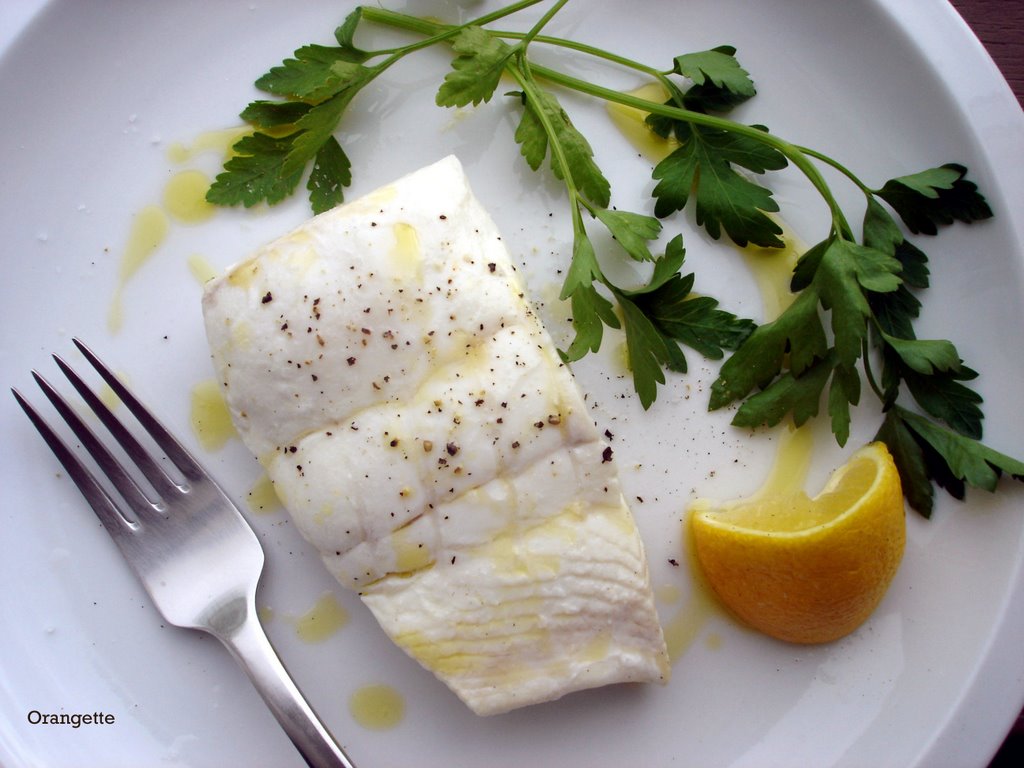
Until a few nights ago, I never would have imagined myself stumping for poached fish, a concept that, for me at least, conjures up visions of pale, pasty, sickly-looking protein, sucked dry—perhaps vampire-style—of all color and nutrients. But this method, from Italy by way of Lynne Rossetto Kasper, has convinced me otherwise. It begins with a skillet of water seasoned with salt, crushed whole garlic cloves, and branches of Italian parsley, and it ends with a plump, snowy-fleshed piece of halibut, silky and fragrant. Along the way, the water is transformed into a salty, herbal broth—like seawater, but better—which infuses the fish and coaxes out its clean, sweet flavor. The garlic softens and mellows, ceding its sharp bite for round edges, winding itself gently around the fish and following it to the plate. Finished with a squeeze of fresh lemon and a slip of olive oil, this is no cafeteria-style fish. It’s more like spring in piscine form—and a very good prelude to dessert.


Poached Halibut with Sweet Garlic, Parsley, and Lemon
Adapted from Lynne Rossetto Kasper’s Weeknight Kitchen newsletter

The key to this preparation is Freshness, with a capital F. This dish is built to showcase the clean, delicate flavor of fresh fish and nothing less. Ask your local fishmonger—or even the fish guy at the grocery store, if that’s your best option—when he gets his deliveries, and save this recipe for those days. If you are in Seattle, get yourself—quickly!—over to Wild Salmon Seafood Market, where the fishmongers know their business and get halibut, fresh off the boats, once or twice a day. Likewise, make sure that you use a good, fresh head of garlic: there should be no green shoots poking from the top, and each clove should feel smooth, solid, and not the least bit spongy. And be sure to use an olive oil that, as Rossetto Kasper says, you would want to eat from a spoon. From there, it’s hard to go wrong.

4 cloves garlic, peeled and crushed
8 branches Italian parsley
1 tsp salt
Water
2 (~6-oz.) halibut fillets, skin removed, or another firm, white-fleshed fish such as cod, tilapia, or catfish
Additional Italian parsley branches, for garnish
2-4 juicy lemon wedges, for garnish
Good-tasting extra-virgin olive oil, for serving
Salt
Pepper

Place the garlic, Italian parsley, and salt in a 12-inch skillet or sauté pan. Add water to a depth of about 2 inches. Bring to a simmer, cover, and let cook for 5 minutes. It should smell very fragrant.

Meanwhile, measure the thickness of the halibut fillets. They will cook for 8 to 10 minutes per inch of thickness.

When the poaching liquid is ready, slip the fillets gently into the pan. Cook for 8 to 10 minutes per inch, adjusting the heat so that the liquid just trembles: it should only bubble a little, and very gently. To test the fish for doneness, make a small slit with a paring knife in the thickest part of the fillet: all but the very center of each piece should be opaque.

When each fillet is ready, use a slotted spatula to transfer it to a serving plate. Garnish the plates with sprigs of Italian parsley and lemon wedges. Serve immediately, allowing each eater to season their fish at the table with olive oil, salt, pepper, and freshly squeezed lemon.

Yield: 2 servings

Note: If you choose to halve this recipe, do not halve the amount of poaching liquid and aromatics. Halve only the amount of fish.

lunes, 1 de mayo de 2006

Celebrity cake

Try as I might to steel myself, I am a total sucker for celebrity gossip. It started early, with those candylike copies of People that my mother and I would sneak home from the grocery store. It was only every now and then, but it must have been too much, because today I am nearly helpless before each new display of Us Weekly. I’m the one holding up your checkout line while I eyeball Angelina’s belly or the slow train wreck that is Britney Spears. When I have an appointment with the doctor or dentist, I almost always go early, just so I can have a few moments alone with the office copy of Star. I once found an abandoned Life&Style Weekly in an airplane seat and nearly snarled at my neighbor, teeth bared, as I jumped to snatch it. The sex, the scandal, the honor betrayed: it’s sick, I know, but sometimes, I tell myself that it’s just like Shakespeare, without the messy encumbrance of rhyme and meter.

Plus, there’s the fact that celebrities eat, and that paparazzi photos sometimes include a stray coffee cup, cookie, hot dog, or half-eaten salad. This fact alone vindicates my voyeurism: it’s research, really, into another form of food journalism. So-and-So was seen at Sarabeth’s, where, according to the manager, she “really put away the strawberry-rhubarb jam.” Or, So-and-So keeps macrobiotic, but is rumored to have a weakness for Mike and Ike and Diet Coke. At So-and-So’s birthday party, waiters clad only in bronze paint passed Moroccan-spiced lamb lollypops with harissa foam, and revelers wore bracelets strung with couscous. It’s the mundane, but set in Malibu or Manhattan, and with more garden parties. Seattle doesn’t often generate that caliber of celebrity news, so a girl’s got to get it elsewhere, like Us Weekly.

Unless, of course, the president of China should happen to stop in for a visit at Microsoft, and our own homegrown, sweater-clad, sort-of celebrity, Mr. Bill Gates, decides to invite him over for an evening of hobnobbing and cake, creating quite a stir on the local scene. Politics and software preferences aside, people love a good, flashy motorcade, especially when it leads to a dinner party. Even The Seattle Times got in on the gossip—and got a recipe too.


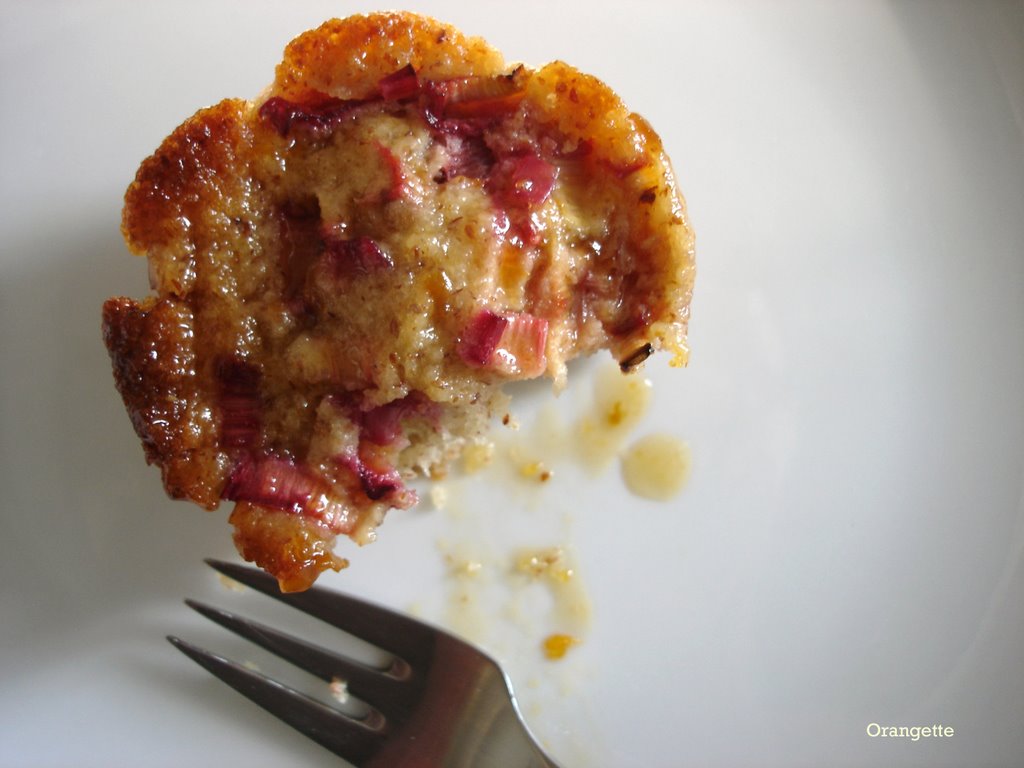
It isn’t often that celebrity news—local or otherwise—inspires me into the kitchen, but when I read that dessert at the Gates residence was a brown butter – almond cake topped with rhubarb, I printed the recipe, fired up the oven, and reached for the mixing bowl. Soon, there was a pan of butter on the stove, burbling its way to brown, and not too long after came nearly a dozen little cakes, squatting atop the counter. Dotted with shards of rhubarb and sporting a homey, tousled top, they smelled unmistakably nutty and not too sweet—earthy and toasty, with a faint caramel edge. Inside, the crumb was classic torte: tight, tender, and very, very rich. Painted with a thin, shiny glaze of apricot jam, they would be worthy of any So-and-So, or even a Page Six mention—if, of course, Seattle had that sort of thing.


Brown Butter - Almond Cakelets with Rhubarb
Adapted from The Seattle Times and Pastry Chef David Jue

I know, I know. The amount of butter called for here sounds absolutely ungodly, and it is. If it’s any consolation, it shrinks as it browns, so it at least looks less scary, even if it’s just as fatty. Remember: all that sweetly browned fat contributes a lot of flavor to these little cakes. It’s worth it—every now and then, at least.

¾ lb. (3 sticks) unsalted butter
1 cup almond flour (also sold as “almond meal”)
½ cup unbleached all-purpose flour
1 2/3 cups powdered sugar
5 large egg whites
1/3 lb. rhubarb, finely chopped
Apricot jam, for glazing (optional)
Loosely whipped cream or ice cream, for serving (optional)

Put the butter in a medium, heavy-bottomed saucepan over medium heat, and stir until it turns a dark amber color, similar to maple syrup, about 10-15 minutes. Remove the butter from the heat, and strain it through a cheesecloth-lined sieve into a small bowl to remove the foamy butter solids and any dark sediment. The butter should smell deeply caramelly. Set it aside to cool, but do not allow it to harden.

When the butter is cool, weigh it. You should have 6 ounces for this recipe, and 3 sticks, when browned, yields just a bit too much. Set a small bowl atop a scale, zero the scale, and pour exactly 6 ounces of browned butter into the bowl. This is what you will use for the recipe; any remaining butter can be stored in an airtight container in the refrigerator for other uses.

In a large bowl, sift together the almond flour, all-purpose flour, and powdered sugar. Add the egg whites, and stir with a rubber spatula to combine. It will look a little odd and slimy. Add the brown butter, and fold until smooth. The batter will at first look strange and oily, but keep folding and stirring gently, and it will come together. Refrigerate, covered, for at least one hour and up to a day.

When you are ready to bake the cakes, preheat the oven to 350 degrees Fahrenheit. Lightly butter or spray 10 (½-cup) muffin cups.

Scoop the batter by ¼-cupfuls into the prepared muffin cups. The batter should be thick and dense: you may want to spoon it into the measuring cup, and then scrape the contents into the muffin cup. Sprinkle about 1 ½ Tbs minced rhubarb on top, and lightly press the rhubarb into the batter. Bake the cakes for 25-30 minutes, or until the edges are lightly browned and the tops look dry. Allow them to cool in the pan for 10 minutes. Run a knife around the edges to release them, and remove them to a rack to cool completely.

If you want to glaze the cakes, warm two or three spoonfuls of apricot jam and a drizzle of water in a small saucepan over low heat. When the jam is loose and melted, brush and dab it lightly over each cake. Serve plain, or, if you like, with loosely whipped cream or a small scoop of slightly softened ice cream.

Yield: 10 cakelets