lunes, 26 de febrero de 2007

I really, really shouldn't

The other day it occurred to me that I’ve hardly said a peep about the book. Seeing as I spend every day in its (nascent) company, it seems like a funny oversight. It hasn’t been intentional, I swear. We’re just slowly feeling our way, this little book and I. Sometimes I feel so absorbed in it, tweaking recipes and jotting down stories, that it’s hard to know where to start.

To tell you the truth, it was a little disorienting at first to be at home at midday, without the reassuring constraints of a time sheet or colleagues. But it would be awfully rich to mope, I soon realized, about any situation that allows me to stay in my bathrobe until noon. (On occasion, you know, only on occasion.) Most days, I hover between the couch and the kitchen counter, writing or cooking or researching something, and then writing some more. In the past week, I’ve written essays about roasted tomatoes and eggs. I developed a soup and a pasta dish and tested each twice, as well as a cake, which will soon undergo its fourth – and sweet lord, please let it be final – session of test-and-tweak. The other night, our friend Sam came for dinner. Watching me swirl a pan of caramel, he asked teasingly if I’d worked up any sort of plan, exercise-wise, to combat the ill effects of recipe testing and tasting. Sure, I said. The plan is to keep a pack of hungry friends nipping at my heels at all times, and to have plenty of loud, raucous dinner parties. I feel good about the plan.

So far, things are going pretty well, although I did eat the better part of a loaf of banana bread last weekend. What’s worse is that it wasn’t even for the book.


The book will have a banana bread, of course – no work of mine will be without a banana baked something – but Banana Bread Week is long over. It was two weeks ago, not last weekend. It’s done. I was after an improved version of this old favorite, a banana bread with chocolate and crystallized ginger. So I read; I compared; and I baked some loaves. Then I called our friends Olaiya and John, and one night, we held a taste-off. A winner was declared, and the recipe has since moved firmly into the hands of a few kind souls who have offered their services as recipe testers. All told, this means that I should no longer be baking banana bread. Where bananas are concerned, I should strap on a pair of blinders, like those horses that pull carriages in Central Park. I should not do what I did last Friday, which was to bake another one.

I think my belly is exerting some sort of force field for banana bread. Recipes come to me, entirely without my trying. For example, when Brandon and I were in Portland for Valentine’s Day, we stopped into Powell’s – after Pearl Bakery, of course – and came away with a lovely (on sale!) book called HomeBaking, by that food-writing duo of dreams, Jeffrey Alford and Naomi Duguid. Between its covers lie about a million recipes, all sorts of savories and sweet things, loaves and cakes and buns galore. But the recipe that caught my eye was – oh Molly, you are predictable – a banana bread with coconut and a splash of dark rum.

I made it last Friday, cursing myself the whole way. And the long and short of it is this: it’s delicious. I thank my lucky force field. Aside from my own little heartthrob of a recipe – which is, anyway, a wholly different animal from this one – it’s my new standby.

I was initially skeptical. As you will note, this recipe has no eggs, which struck me as odd. But I decided not to second-guess: it might not work, I figured, but that might be for the best. But work it did, and brilliantly, hooo boy, baking up into a pretty little loaf with a moist, compact crumb. As banana breads go, this one is more bread-like and less cakey than some, and that works wondrously to its advantage. It’s subtle – not rich or cloying – and its soft, sturdy crumb gets a bit of toothsome interest from a handful of shredded coconut. This last also lends a faint, nutty flavor that, along with the aforementioned rum, makes for a very complex, sophisticated sweet. Even the crust is special, with a crunchy, nubbly top that crackles with demerara sugar. If banana bread, as a general category, is the ultimate in Americana, this particular loaf sits at the edge of the map, on one of those exotic tropical territories where rum is de rigueur. I think you’ll agree that right about now, that sounds like very good place to be.


But the best part is that a slice or two, along with a cup of tea, makes for one heck of a breakfast. That means there’s good reason to bake another loaf – we have to eat breakfast, people! – even though, by all accounts, I really, really shouldn’t.


Banana-Coconut Bread
Adapted from HomeBaking: The Artful Mix of Flour and Tradition around the World, by Jeffrey Alford and Naomi Duguid

I have one word for you: demerara. This bread is lovely in its own right, but it owes a good deal of its charm to this very special sugar. Demerara has large, golden grains that sparkle in the light, and sprinkled on top of this banana-moistened batter, it yields a crisp, sweetly craggy crust that steals the show - and that stays crunchy on the second day, even! You can buy demerara sugar online from any number of sources, or look for it in your local gourmet store. I found mine at an upscale market nearby, and I think Whole Foods also carries it. Either way, buy it. If you’re anything like me, you’ll want to sprinkle it all over the place.

About 3 large, overripe bananas
2 cups unbleached all-purpose flour
¾ tsp. baking soda
½ tsp. freshly grated nutmeg
Pinch of salt
1 stick (4 ounces) unsalted butter, at room temperature
1 cup granulated sugar
1/8 tsp distilled white vinegar
1 ½ Tbsp. dark rum
½ cup dried shredded unsweetened coconut
1 Tbsp. demerara or dark brown sugar

Preheat the oven to 350 degrees Fahrenheit. Butter a standard-size loaf pan.

In a blender or food processor, purée the bananas. Measure out 1 ½ cups of purée. [If you have more than that, try stirring the excess into some plain yogurt. It’s delicious.] Set the purée aside.

In a medium bowl, whisk together the flour, baking soda, nutmeg, and salt. Set aside.

In a large bowl (or the bowl of a stand mixer), beat together the butter and sugar until light and fluffy. Add the vinegar and rum, and beat to mix well. Add the banana purée and the flour mixture alternately, about 1 cup at a time, beginning with the banana and beating to just incorporate. Use a spatula to fold in any flour that has not been absorbed, and stir in the coconut. Do not overmix.

Scrape the batter – it will be thick – into the prepared pan. Smooth the top, and sprinkle evenly with the demerara sugar. Bake for 50-65 minutes, or until the top is nicely browned and a toothpick inserted in the center comes out clean. Let cool on a wire rack for about 20 minutes; then turn the loaf out of the pan and allow it to cool completely.

This loaf will keep, sealed airtight, for three to four days, although it is best, I think, on the second day.

Note: You can use frozen bananas here too, and with beautiful results. Whenever I have overripe bananas sitting on my counter, I throw them – skin and all – into the freezer for safekeeping. When I want to bake with them, I pull them out a few hours before, put them in a wide, shallow bowl, and let them thaw. When they have softened fully, I tear open the skin and let the soft, slippery flesh spill out. Be sure to save any juices that come out with it; they’re very flavorful and can be puréed along with the flesh.

Yield: 1 loaf

lunes, 19 de febrero de 2007

What the salad bowl has joined together

Many years ago, long before I was old enough to care about such things, my mother told me that she didn’t like escarole. It didn’t mean much at the time. I didn’t even know what esca­whatever was, nor, for that matter, why anyone would have an opinion about it. It was one of those wisps of information that blow through a childhood like tumbleweeds – quiet, aimless, a part of the background – those errant bits that, though we hardly know why, we sometimes hold onto. Like, say, the fact that my uncle Chris took his eggs with Tabasco sauce. Or the story of that horse who bit my uncle Jerry, and whom my uncle Jerry bit right back. That’s what escarole was like. My mom didn’t care for it, and that’s what I knew. I never thought to ask or wonder. And until pretty recently, I also never thought to actually try the stuff.

To her credit, my mother has since told me that back in those days, she didn’t really know what escarole was, either. She thought it was a funny sort of lettuce, bitter and unpleasant, though she’s not sure why. Maybe my grandmother didn’t like it. Go figure. At this point, it doesn’t much matter, because I’ve broken rank. This winter, I’ve fallen head-over-snow-boots for escarole. Never mind that it took me some twenty-odd years to try it: what the salad bowl has joined together, let no man put asunder.


Now, it didn’t happen overnight, mind you. It was a process, and I credit my friend Kate with getting it started. One night a year or so ago, she invited me over for what she called “crazy fiery Chinese fish,” also known as filets of salmon, lightly steamed and then doused in soy sauce with scallions and fresh ginger, with a slug of sputtering, near-boiling oil poured over the top. [A family specialty and quite delicious, if dangerous.] She served it with steamed white rice to soak up the juices and, as it would happen, a head of escarole that she had tossed quickly in a hot skillet and plated with wedges of lemon. I was stunned to find it such a likable thing: a spectrum of whites and pale greens, silky in spots, crisp in others, with a faintly edgy chicory flavor. It was a very good start. It got me at least looking every now and then in the direction of escarole, even if I wasn’t sure what to do with it.

But then, oh then, enter the salad bowl. Brandon had once told me that his old friend Steve often made salads with escarole, so a couple of months ago, faced with a very poor selection of greens at the market, we picked up a head and brought it home. Just like that. We’ve been eating escarole salads ever since. After all that fuss, I feel kind of pathetic. There’s hardly even a story to tell. As it turns out, escarole is easy to love. Especially its pale heart, which, when served raw, is actually a little sweeter than standard lettuce and barely bitter at all. It’s the only salad green I know to be leafy and crisp in the same bite, soft and resilient and springy under the fork. I don’t like escarole. I flat-out love it.

In recent weeks, we’ve tried a few variations on the escarole salad theme, including one at Zuni Café in San Francisco, with persimmons and pomegranate seeds and a fancy local olive oil. But the version I keep returning to is one of the simplest, a study in yellow and green. We chop the escarole into coarse shreds, chuck into a bowl with some shavings from a piece of Parmigiano Reggiano, and coat it with a variation on my usual vinaigrette. Then, at the table, it gets a few lashings of creamy avocado and some more shavings of cheese. All told, it’s our new house salad, and one that I’m happy to share with you. It was our Friday dinner. It was our Sunday lunch. And if the avocados on the counter continue to ripen as planned, for a little while at least, it may be our every meal.


Escarole Salad with Avocado and Parmesan

Now is the time for escarole. It’s in season from December to April, before summer’s greens shove it aside. When choosing your escarole, look for heads with large, pale yellow hearts. That’s the best and most valuable part. For our purposes, the darker outer leaves exist mainly to protect the inner ones and, in the process, can tend to get tough and slightly bitter. Once you’ve bought your escarole, wash it thoroughly: it’s dirty business. Brandon once saw Mario Batali – back in the beautiful early years of Molto Mario – soak his in multiple changes of cold water, so that’s what we do, as you’ll see in the instructions that follow.

The quantities below make a light Sunday lunch for two, along with some crusty bread and fruit to finish, but this salad could also serve three or four as a starter or side dish. You’ll likely have dressing left over, but since it works with nearly any salad, it shouldn’t cause too much trouble. Should you happen to be a fancy-vinegar fiend, you might try this salad with cognac vinegar. We had a Williams-Sonoma gift certificate to burn, so we picked up a bottle one day last fall, and it’s pretty wonderful here. Lastly, for other escarole salad ideas, hop over and read Tea’s take on the theme.


1 head escarole (for reference, ours have generally weighed about 9 ounces each)
½ firm-ripe avocado
A hunk of Parmigiano Reggiano
Crunchy sea salt, such as Maldon or fleur de sel

For the dressing:
1 Tbsp. Dijon mustard, preferably Grey Poupon
3 Tbsp. champagne vinegar
½ tsp. fine sea salt
5 Tbsp. olive oil

First, prepare the escarole. Pull off the outer layer of leaves, as well as any other tough, raggedy-looking ones, and set them aside for another use. [I like to sauté them over high heat and finish them with lemon, sort of like this.] Cut the head in half from stem to tip, and then cut each half crosswise into coarse strips about 1 inch wide. Pile the escarole into the basket of a salad spinner, place the basket inside its bowl, and fill with cold water. Swish the leaves around and let them soak for a minute or two; then pull the basket out of the bowl to drain them. Dump the water from the bowl and rinse it well to remove any dirt. Place the basket in the bowl again, fill with cold water once more, and soak the leaves again. Pull the basket from the bowl, and shake off any excess water. Dump the water from the bowl, place the basket inside, and spin the leaves until they are well dried. Turn them out into a salad bowl.

While the escarole is soaking, make the dressing. In a small bowl, combine the mustard, vinegar, and salt, and whisk well to combine. Add the oil a tablespoon at a time, whisking continuously to emulsify. Taste, and adjust vinegar-oil balance, if necessary.

Cut the avocado into thin slices. Place them in a bowl or on a plate, and set them on the table.

Using a vegetable peeler, shave a small palmful of Parmigiano Reggiano over the escarole in the bowl. Add a good splash of dressing, and toss to combine. Taste, and add dressing until the salad is dressed to your liking. Serve, with avocado, additional shavings of Parmigiano, and crunchy sea salt to taste.

Yield: 2 Sunday-lunch-size servings

lunes, 12 de febrero de 2007

Something heartfelt

Before I begin, I have to assure you that it’s not really as bad as it may seem. I’m not a curmudgeon, I swear. I’m not one of those bitter types who while away February by spitting on the displays of pink-and-red heart garlands in the grocery store. (Although, come to think of it, now that I’ve written that sentence, if I were a curmudgeon, I’d know exactly what to do.) It’s just that Valentine’s Day doesn’t really excite me. It’s not like Thanksgiving or Christmas, those holidays that come with catchy tunes to hum under your breath, the holidays that invite all sorts of baking and splurging and beautiful, endless buffet tables. Valentine’s Day feels a little stilted, that’s all. Too often, it’s like an obstacle course or a big end-of-term exam, a test to prove how good you are, or how impossibly romantic you can be. I like my romance under less fraught circumstances. It just feels more romantic that way.

Maybe I shouldn’t admit this, but I don’t even remember what Brandon and I did last Valentine’s Day. I have no idea. I don’t even know if we were in the same city. I’m sure it was nice, whatever it was, but to tell you the truth, it has nothing on any number of other, more ordinary days. Like, for example, one Saturday last July. I think of that day a lot. It was overcast, and we left at midday and drove north to Bellingham. We had a bag of spicy peanuts in the console, and I was wearing a new pair of shoes. We stopped at a Goodwill near Mount Vernon and bought a Pyrex dish that I love, and then we ate spaghetti with pesto for dinner. Our canopy bed at the Best Western was nearly four feet high – it had stairs, people – and the next morning, when I tried to climb down, I banged my hip on the bedside table and got a whopper of a bruise. We laughed about it for a long time. I loved that trip.

Or then there was September 15, the day after my birthday, the day that Brandon spent sitting on the floor of my family’s kitchen in Oklahoma City, wrestling contentedly with a rusty bolt in my father’s old espresso machine. He spent hours sitting there, watching us come and go, rigging and wrenching and wielding a can of WD-40. When he finally pried the bugger loose, the machine shuddered to life with a squeal and a roar, a sound none of us had heard since my father died. Brandon worked the knobs with a sort of sweet, fearful reverence, and my mother fawned over her cappuccino for hours.

Or there’s that time a few weeks ago, when we decided that dinner at home was too much trouble and drove instead to Malena’s, as we sometimes do. The cilantro on my beans was a little wilted, but the guacamole was good, and so were the tortillas. We sat next to the heating vent, under the fluorescent tubes, and I tickled my foot along his calf, and all of it cost under nine dollars. I’d take any of these for a Valentine’s Day. They’re good enough for me. A special holiday for lovers is a very nice idea, but I’d much rather a little daily something heartfelt – a touch, a look, a table for two at a tacqueria – instead.

So I’m not a big Valentine’s buff. I don’t need any fancy celebrations or fanfare. (Never mind that Brandon has apparently planned some sort of huge, secret to-do for this Wednesday, nor that he is so impatient to share it with me that he asks at least once a day, “Do you want me to tell you what it is? No? Are you sure?” I know I will love it, whatever it is – but mainly because he’s so unbearably cute when he’s scheming and planning and itching to tell a secret, not so much because it’s Valentine’s Day.) For me, a quiet dinner is just fine. Or better than fine, even, especially when it concludes on the couch, with sleek, squidgy wedges cut from a chocolate tart.


I know, because that was our Saturday. I didn’t want to interfere with Brandon’s secret scheme for Wednesday, so this weekend I made us an early Valentine’s dinner. We started with a favorite salad, a purply jumble of slivered red cabbage and lemon, and then moved on to panade, which is pretty plush and sexy as winter dishes go. (It is also quite filling; be warned.) It was a good meal, minus the part where I got painfully hungry before supper was ready and Brandon had to step in to make the salad while I, in a panic, set the table. But the best part was undoubtedly the tart.

I had seen it in the most recent issue of Gourmet – (I know, I know, I’m starting to get redundant) – and it looked too good to ignore. Brandon agreed, and so I made it. The process was astoundingly easy: a press-in chocolate cookie crust filled with a spiffed-up, five-minute ganache, baked and chilled and dusted with cocoa. Moreover, it was delicious. Dense and silky, heartstoppingly rich, it was like eating the centers out of a half-dozen truffles, only without the mess. Its crust had just the right amount of crisp and shatter and, we noticed, the faintest caramelly flavor at its edges, where the butter had begun to brown against the hot pan. And, need I repeat, it was easy, which meant less time for cleanup and more for Brandon, and for our latest Netflix borrow. He even covered my eyes during the gory parts, and that, more than any grocery store garland, is love.


Chocolate Truffle Tart
Adapted from Gourmet, February 2007

In my humble opinion, the most important thing to know about this tart is that it improves with age. It was good on the first day, yes, but it was tremendous on the second. TREMENDOUS! So if you plan to serve it on Wednesday, try to make it tomorrow, or even tonight. Hop to it!

As for types of chocolate, I have to admit that I took the pitiful, what’s-in-the-pantry route. I used Ghirardelli 60% bittersweet chips. With any other brand, I wouldn’t even consider using chips – they just don’t melt like baking chocolate – but Ghirardelli works beautifully. And although it is kind of a plain-tasting chocolate, it was perfect here, yielding a wonderfully complex, fruity flavor. I imagine that Valrhona could also be good, although I wouldn’t use Scharffen Berger, which is already incredibly fruity to start with. It would be too much.

As for the pan, I only had a 9-inch springform, not the 8-inch version called for by Gourmet. The tart turned out just fine, but as you might expect, it was a little on the thin side, with the filling maxing out around a half-inch thick. So if you have an 8-inch springform pan, use it. And if you only have a 9-inch, know that your tart might look a little skinny. Pretty, but skinny.

Lastly – whew! – Gourmet calls for this tart to be served chilled, straight from the fridge, but we greatly preferred it after an hour or two at room temperature. When chilled, the filling is sort of chewy and squeaky, but after a little rest on the countertop, it softens a little and gets pleasantly silky. Much better.


For the crust:
28 chocolate wafers such as Nabisco Famous, finely ground in a food processor (1 ½ cups)
6 Tbsp. unsalted butter, melted and cooled

For the filling:
½ lb. good-quality bittersweet chocolate (no more than 60% cacao), coarsely chopped
6 Tbsp. unsalted butter, cut into ½-inch cubes
2 large eggs
1/3 cup heavy cream
¼ cup granulated sugar
¼ tsp salt
1 tsp. pure vanilla extract
Unsweetened cocoa, for dusting the finished tart

To prepare the crust:
Put an oven rack in the middle position, and preheat the oven to 350 degrees Fahrenheit. Wrap a sheet of foil around the outside of an 8-inch round springform pan, to catch any possible leaks. Lightly butter the sides of the pan.

In a medium bowl, stir together the ground wafers and melted butter until well combined. Turn the mixture into the pan and, using your hands, pat it evenly onto the bottom and 1 ½ inches up the side. Slide the pan into the oven, and bake until the crust is slightly puffed, about 10 minutes. Cool completely on a wire rack, about 15 minutes. Leave the oven on.

To prepare the filling:
While the crust cools, melt the chocolate and butter, stirring occasionally until smooth, in a double boiler or a metal bowl set over – but not touching – barely simmering water. Remove the mixture from the heat and set aside to cool for 5 minutes.

In a medium bowl, whisk the eggs lightly. Add the cream, sugar, salt, and vanilla, and whisk to combine well. Add the chocolate mixture, and whisk to combine well.

To assemble the tart:
Pour the filling into the cooled crust, smooth it gently with the back of a spoon or a rubber spatula, and rap the pan once on the counter to eliminate any air bubbles. Slide the pan carefully into the oven, and bake until the filling 1 inch from the edge is set and slightly puffed but the center still trembles a little when the pan is gently shaken, 20-25 minutes. The center will continue to set as it cools.

Cool the tart completely in the pan on a wire rack, about 2 hours. Chill, uncovered, until the center is firm, about 4 hours. About 1 to 2 hours before serving, remove the tart from the fridge and carefully pull away the side of the pan. Put a teaspoon or two of cocoa in a small sieve, and dust it over the cake. Allow to sit at room temperature for an hour or two; then serve.

Note: If you’re short on time – which you may be, since Valentine’s Day falls on a Wednesday – you can make the crust and filling and bake the tart a day or two ahead. When the tart is completely chilled, cover it loosely with foil. (Covering it before it is fully chilled can cause condensation.) The finished tart will keep, according to Gourmet, in the fridge for three days.

Yield: 8-12 servings

lunes, 5 de febrero de 2007

The soupiest month

February always feels to me like a funny limbo period. Winter has gone sort of tired and stale, but still, short sleeves are a little way away. Over most of the northern globe, it’s nippy, damp, and grim. February is the shortest month, the Valentine’s month, the scant sum of four weeks of frost and fog and those funky, crumbly candy hearts. It isn’t much to speak of, quite honestly, except for all the soup.

The way I see it, February is the soupiest month. The giddy hubbub of holiday cooking is behind us, and summer barbeques feel like pure fantasy. So here in the middle, in Limbo Land, it’s high time for soup. All I want these days is a bowl and spoon – and soup at noon, stew for supper, stock in the fridge, broth on the stove, soup soup soup! What with all the spoonable meals around here, you’d think I’d had some sort of major oral surgery. But nah, it’s just Old February, sticking its fingers in the stockpot again.

And take it from me: when it does that, it’s best not to resist. If I were you, I’d fire up the stove, throw a few potatoes its way, and call it locro de papas.


Mine looks nothing like the photograph in this month’s Gourmet, but I don’t care one bit, because this Andean potato stew is a deep-winter dream. It’s warming, rustic, and immeasurably soothing, the sort of soup that makes you want to dock your spoon at the bottom of the bowl and hang out, right there, for a little while. I can think of many worse ways to spend February – can’t you? – than in the company of potatoes like these, stewed into a mellow, cumin-scented broth and smoothed with milk and crumbly Mexican cheese. Creamy and subtle, topped with crescents of avocado, it’s a little homey, a little homely, and quietly delicious – in other words, just the kind of food for February.

Now, that said, I should warn you, however, that this is not Saint Valentine’s fare. That’s not what it’s for. There are plenty of other, sexier dishes to spoon delicately into someone else’s mouth. (Ding, ding! Hello, chocolate!) This one is just for you. It’s for a gray day, to be eaten in a cool room, and with a wool blanket across your lap. I’ve been doing just that since late last week, and I’m not the least bit sick of it yet. In fact, I’d be happy to drop anchor here indefinitely – (Can you tell we watched both Pirates of the Caribbean movies this weekend? Argh, matey.) – so long as the supply of avocado holds up. Or until the end of the month, whichever comes first.

Locro de papas
Adapted from Gourmet, February 2007

Fancy it ain’t, but pay no mind, because this potato stew is a keeper. The only tricky thing about this recipe is the annatto – also known as achiote – seeds. They’re small, triangular, rust-colored pellets that bring a red color and earthy, resinous flavor to many Latin American, Caribbean, and Filipino dishes. That means, unfortunately, that they’re a little tough to find in the typical American grocery store. I bought mine at World Spice, but you could probably find them at your local Latin American or Mexican grocery, or at Penzey’s.

And while we’re on the topic of annatto, a word to the wise: when you make your annatto oil, below, use a stainless (or other light-colored) saucepan or skillet. I made the mistake of reaching for our well-seasoned omelet pan, which is black as tar and therefore made it damn near impossible for me to gauge the color of the oil as it steeped. And judging by the fact that my soup looks nothing like the sweetly burnished red-orange business in Gourmet, I think it’s safe to assume that I didn’t let my oil get red enough. Or that Gourmet did some sort of tricky retouching. Either way, don’t use a dark pan, and don’t say I didn’t warn you.

2 tsp. annatto (achiote) seeds
2 Tbsp. olive oil
3 ½ lb. russet (baking) potatoes
1 cup chopped yellow onion (about 1 medium)
Rounded ½ tsp. ground cumin
2 ¼ tsp. salt
A few grinds black pepper
7 cups water
1 cup whole milk
1 ¼ cups coarsely grated queso fresco or queso blanco
2 firm-ripe avocados

In a small saucepan or skillet, heat the annatto seeds and oil over low heat, swirling the pan often, until the oil is bright red-orange and barely simmering, about 2 minutes. Remove the pan from the heat, and set aside to rest for 10 minutes.

While the annatto oil is resting, fill a large bowl with cold water. Peel the potatoes and cut them into ¾-inch chunks, dropping them into the bowl of water as you go. The water will help to prevent discoloration.

Pour the annatto oil through a fine-mesh sieve into a large (7-8 quart) pot, discarding the seeds. Warm the oil over medium-high heat, and add the onions and half of the potatoes. Cook, stirring frequently, until the onion is softened, about 4-5 minutes. Add the cumin, salt, and pepper, and cook, stirring, for 1 minute more. Add the water, stir to scrape up any brown bits stuck to the bottom of the pot, and bring to a boil. Reduce the heat and simmer, partially covered, until the potatoes are very tender, about 25-30 minutes; then mash the potatoes into the broth. (You could do this with a potato masher, I assume, but I couldn’t find ours – the kitchen utensils drawer is a madhouse – so I used my immersion blender instead.) Remove the remaining potatoes from their bowl of water, drain them well, and add them to the pot. Simmer, partially covered, until they are tender, about 20 minutes more. Stir in the milk and the cheese, and increase the heat to bring the pot to a simmer again, stirring. Remove from the heat.

Cut the avocados into small cubes or slices. Ladle the soup into bowls, top with avocado, and serve.

Yield: About 6 servings

lunes, 29 de enero de 2007

The usual

I have this funny thing about recipes. When I find one that I like - for, oh, let’s say, lentil soup - I have a hard time trying others in the same genre. I will, of course, but in most cases, I would be just as happy to rest on my laurels and sit there, sipping that same lentil soup, until the end of time. This is not good behavior, I know, for someone who supposedly cares about cooking. I’m supposed to be some sort of happy mad scientist, a real free spirit, some sort of kitchen sprite with a spoon and a stand mixer and a relentless sense of curiosity. Sometimes I am. But most of the time, I’m not. I can’t help it. I’m loyal, and sentimental, and when something clicks with me, I want to keep it around. That goes not only for recipes, but also for beauty products, and men.

But about the recipes: take, for instance, my sister’s Scottish scones. I’ve written about them here before - twice, actually. In the whole wide, nubbly world of scones, they’re my very favorite. They’re the sort of thing that you’d eat, I imagine, before setting out for a brisk, rousing hike in the Scottish Highlands. Solid, tidy things, they have a dense, tight-woven crumb that tears apart into fat, flaky layers. They bear a close resemblance to a biscuit, but more delicate and dainty, with a flavor that’s more flour and less fat. Scones seem to run a spectrum these days: at one end sits the fluffy, muffinesque camp, and at the other, the sturdy, Old World, biscuit-like type. My sister’s rest delectably among the latter, which is just where I want them. Forever.

However, I do have a rather fat collection of cookbooks, not to mention an ever-growing accordion file of recipe clippings, and they demand my attention every now and then. They’re very annoying that way. You wouldn’t believe how pushy they are. They throw themselves at me. They lie next to my bed like flat, lazy dogs. They stretch and yawn all over my lap. And sometimes, like yesterday, they tell me about scone recipes that aren’t my sister’s. The nerve. I swear.

What’s worse is that I listened, and liked it.


This recipe isn’t replacing my sister’s quite yet, but that’s only because I’m very, very stubborn. If my sister’s scones are Scotland, these are Seattle - not only because they were developed nearby, at Macrina Bakery, but also because they’re decidedly New World, made for a city with a Space Needle. These craggy, homespun beauties have a thin, golden crust and a rich, cakey crumb that’s a little like a muffin, but with more moxie. A twist on the classic cream scone, they’re made without eggs or butter, getting their body, richness, and flavor from a generous dose of heavy cream instead. But what sets them apart from the standard cream scone is a pair of electric beaters. This recipe calls for cream that’s been whipped to the smallest of soft peaks, yielding a dough that feels wonderfully light and airy, like a cool, downy pillow. The dough rises and puffs as it bakes, making for an open, tender crumb and, I have to say, a totally bang-up scone.

And if you’re not yet sold, I have three more words for you: currants and fennel seeds. They’re in there too. It’s an unusual pairing, I know, but trust me: the winey, wintry currant has never had such a sweet, fresh-faced companion as the fennel seed. And with all that cream, and that lovely crumb? These scones feel like winter and spring baked together in a convenient, hand-held shape – one that may well become the usual around here.


Cream Scones with Currants and Fennel Seeds
Adapted from Leslie Mackie’s Macrina Bakery and Café Cookbook

I don’t know about you, but when I think of fennel seeds, my mind doesn’t naturally leap to scones – nor, for that matter, to anything remotely of the sweet genre. This recipe, however, has me singing a different tune. Local baker Leslie Mackie is really onto something.

Be sure to use good, fragrant fennel seeds for this – not that bottle of stale ones (ahem) that’s been sitting at the back of the spice drawer for years. I used some wild fennel seeds sent to me last fall by a certain cookiecrumb, and they were delicious.

1 cup dried currants
1 tsp fennel seeds
3 ½ cups unbleached all-purpose flour
¾ cup granulated sugar
2 Tbsp. baking powder
1 tsp salt
2 ½ cups heavy cream, plus 1-2 Tbsp. for glazing

Preheat the oven to 350 degrees Fahrenheit, and line two baking sheets with parchment paper or silicone liners.

Place the currants in a small bowl, and cover them with warm water. Set them aside to plump for ten minutes; then drain.

Meanwhile, in a small skillet, toast the fennel seeds over medium heat for about 1 minute, until fragrant. Pour the seeds into a small dish – if you leave them in the pan, they could burn – and set aside to cool.

In a large bowl, whisk the flour, sugar, baking powder, and salt until thoroughly blended. Add the drained currants and fennel seeds, and stir to incorporate.

Pour 2 ½ cups of the cream into a medium bowl, and beat just until it begins to hold small, soft peaks. It should not be stiff. Using a rubber spatula, gently fold half of the whipped cream into the dry ingredients, and then fold in the second half. When the dry ingredients are absorbed, turn the shaggy dough out onto a floured surface. Coat your hands well with flour, and gently work the dough – pressing and massaging and gathering, but not really kneading – into a rough ball. Do not overwork it: you want it to just come together. Press the dough into a large, thick round, and cut it in half. Form the halves into two smaller rounds, each about 1 inch thick – they need not be pretty, nor particularly even – and cut them into 6 triangles each. Gently transfer the scones onto the prepared baking sheets, and brush their tops with cream.

Bake the scones for 20-25 minutes, rotating the pans halfway through, until pale golden. Serve warm or at room temperature.

Note: These scones - and all scones, for that matter - freeze beautifully in an airtight container or bag. Allow them to thaw to room temperature before reheating in a low oven.

Yield: 12 scones

lunes, 22 de enero de 2007

Brown bag it

One day a few weeks ago, entirely without prompting, Brandon packed me a lunch for work. Just like that. I opened the fridge, and there it was: a Tupperware containing one of his trademark concoctions, soba noodles with a peanut-citrus sauce, with my name on it.

“Oh yeah,” he said nonchalantly, “I thought you might like some for your lunch tomorrow.”

With no explanation, just like that, he packed my lunch. I may be crazy, but it made me feel a little faint. I guess the conventional way to woo a woman would involve roses, or chocolates in a frilly box, or fancy dinners set to a soundtrack of Marvin Gaye. But personally, I think “make her a brown-bag lunch” should be added to the list, right up there with love poems, candlelight, and bearskin rugs. Oh baby.

It’s not as though he never does nice things for me, because he does plenty. For example, he has single-handedly grown my collection of vintage Pyrex dishes from two pieces to sixteen in the span of only six months. [Our local Goodwill loves him.] He regularly fixes our dinner, keeps me plied with pickles, and helps me eat the sweets that I feel strangely compelled to bake each week. [The waistband of my pants loves him too.] But let me tell you, there’s nothing quite so fine as this new brown-bag-lunch business of his. Not so long ago, I used to stand in front of the fridge at a few minutes to midnight, alone, cursing, trying to cobble or cram together something for lunch the next day. Now I feel so loved. As long as he doesn’t start cutting shapes out of my sandwiches with cookie cutters or sending me off with Fruit Roll-Ups, I am so marrying this man next July.

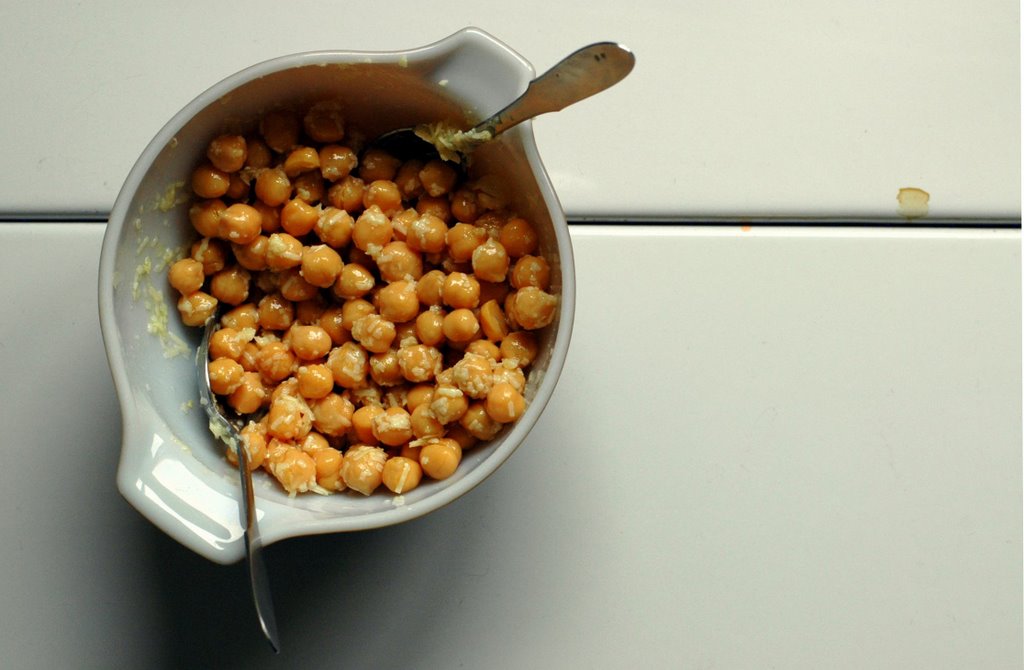
Anyway, since that soba noodle excitement a few weeks ago, Brandon has shared with me another of his favorite standby lunch items, and today I want to share it with you too. It’s a dead-simple chickpea salad, a little something he started making when he was a teenager in a program called “Jazz for Teens” – he’s a saxophonist – and needed a midday meal that he could tote along to his sessions. Back then, he was deep in what I like to call The Garlic Period – those bygone days when he would mix minced raw garlic with salt and spread it on buttered toast – so the original incarnation of this salad was brimming with the stuff. But in the intervening years, he has tweaked and honed his formula, deciding, even, that with a good olive oil and a grating of good cheese, it didn’t need garlic at all. What he’s been feeding me lately is a lovely, mellow salad that I’d be happy to eat every week from here on out. In fact, I might go so far as to say that it’s the best five-minute, five-ingredient meal I know.


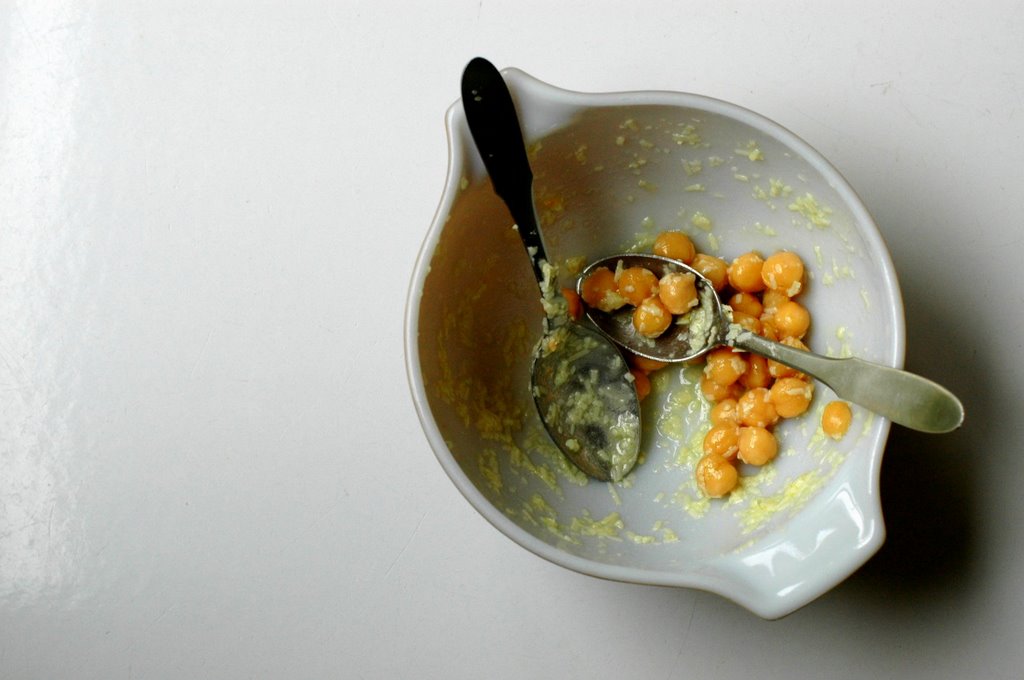
It starts with a can of chickpeas, drained and rinsed and dumped into a bowl. Into the mix goes a squirt of fresh lemon juice, a slip of grassy olive oil, a pinch of salt, and some Parmigiano Reggiano. Stirred together and chilled, it tastes like the sum of its parts – only about 200% percent better. The lemon brightens the légumes, lifting their earthy flavor to something lighter and sweeter, while the olive oil makes them taste richer and more savory, as though they’d been cooked in stock. And the parmesan plays deliciously, as it loves to do, with both the lemon and the oil, binding the whole bowl together with its creamy, resonant charm. All told, it’s tasty enough to make my colleagues chirp jealously, and to make me chase every last chickpea from the container – and then scrape up the nubs and dribbles with a hunk of bread.


It’s such a simple recipe that I’m almost embarrassed to post it here, but because we all need instructions sometimes – especially late at night, when facing a nearly-empty fridge – I will anyway. You might consider eating these chickpeas atop some plump-leafed baby greens, or nestled alongside nearly any vegetable. I’ve also been known to eat them with some sliced radishes and crusty bread on the side, or, um, sometimes, peanut butter and Wasa crackers. Even when I no longer have a job that requires a brown-bag lunch – a week from Thursday, to be precise; whew! – you can bet, come noon, that I’ll still be sitting down to a bowl of this. Maybe with peanut butter and crackers. Some habits die hard, you know.


Chickpea Salad with Lemon and Parmesan

This little salad only has five ingredients, so make sure that they’re all of good quality. There’s no room for second-rate pantry closet cast-offs here, so don’t even think about it, missie. First of all, be sure to use a good brand of chickpeas. I would never have thought about this sort of thing prior to meeting Brandon, Mr. Chana Masala Man, but he’s got me convinced: the best canned chickpeas are produced by Goya, Bush, and Trader Joe’s. Other brands, such as generic supermarket ones, can be mealy, bland, and / or mushy, rather than firm, fat, and earthy-sweet. Also, get out your best olive oil – one you’d want to eat from a spoon, if you’re into that sort of thing. We like to use a dash of this luscious brand, to which we were introduced by the lovely Tea. It really seals the deal.

1 15-ounce can chickpeas, drained and rinsed
1 tsp. fresh lemon juice
1 ½ tsp. olive oil
A pinch of salt
¼ cup loosely packed shredded Parmigiano Reggiano

Combine all ingredients in a bowl, and stir gently to mix. Taste, and adjust seasoning as necessary. Serve immediately, or chill, covered, until serving.

Note: This salad keeps well in the fridge and is, in my humble opinion, best eaten cold.

Yield: 2 servings

lunes, 15 de enero de 2007

My daily bouchon

You guys are to be commended. It takes a very kind, optimistic crowd to greet the homely old celery root with open arms, and by gosh, you did. You’re clearly well schooled in the old saying, “You can’t judge a celery root by its cover.” You’re great.

So after all that good will and pale green soup, you deserve some dessert, don’t you think? I hope you won’t mind if it’s kind of, um, homely. You’re probably used to that by now.


Back in October, I took a weekend trip to Portland, Oregon, for work. I meant to tell you about it then, but I was knee-deep in my book proposal, and it was pretty much all I could do to keep feeding, bathing, and clothing myself, much less write something adequate to such a lovely, lovely city. I fell hard for Portland. It’s my new favorite. Oh, Portland, from your old brick train station to your free light rail, your river, your bridges, and that pair of shoes (cute and comfortable!) that leapt from your storefront into my suitcase, you got me, hook, line, and sinker. And that was before Pearl Bakery, even.

A reader of this site had told me about Pearl Bakery, but I had no idea just how bewitching it would be. Be-witch-ing. I went there three times in three days, friends. I took extra-long lunch breaks. I made it happen. I hoofed across town in high heels. I almost missed my train. I had to have my daily bouchon.


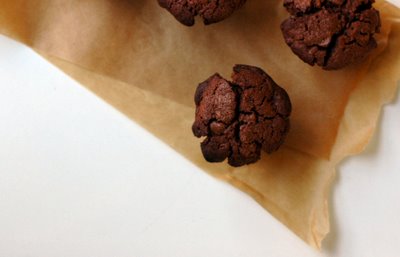
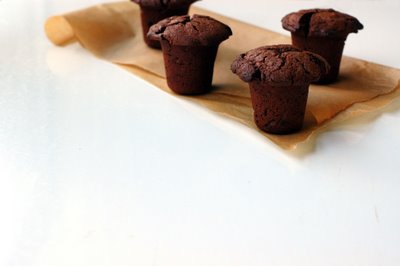
So named – en français – for their faint resemblance to a champagne cork, these little chocolate cakes could have easily kept me in Portland indefinitely, if I hadn’t had that pesky return ticket. Dense and delicate, with a fine, tight crumb, they were unusual in nearly every way – and unusually good. Tinted a deep, reddish brown from plenty of dark chocolate, they sat somewhere between brownie, scone, and day-old chocolate cake, and were studded throughout with semisweet chips. Some could call their texture a tad dry, I guess, but once on the tongue, a mouthful melted almost instantly – at which point, of course, I started pawing for more. This could have been a big problem back in Seattle, as you can imagine, had I not discovered that the recipe for bouchons was waiting on my cookbook shelf.

I’m sure I’m not the first to say it, but thank heavens for David Lebovitz. Within the folds of his Great Book of Chocolate lies the recipe for Pearl Bakery’s funny little beauties, as told to him by pastry chef Lee Posey. And, as with the book’s other recipes – I’ve tried a good handful now – this one works. I made just a few tweaks – substituting regular-size Ghirardelli chips for the mini ones indicated, mainly because I can’t find a worthy brand of the latter, and using a mini popover pan instead of a regular muffin tin – but otherwise, David, wow. Thank you.

With a shape not unlike a pert, stocky mushroom and a deliciously craggly, cracked top, these humble-looking cakelets are chocolate to the core – which is how, I think, we all should strive to be. They’re tailor-made for a chilly afternoon with a girlfriend, or boyfriend, and a good, strong cup of coffee. I can also tell you that they fit quite nicely into a Sunday evening with a couch, a DVD, a bottle of tawny port, my man, and my mother, who was in town for another installment of wedding planning. [Rehearsal dinner site: check. Rehearsal dinner menu: check. Wedding menu: check. Tables, chairs, tents rented: check. Exhausted and cold and tanked on a single glass of port: check!] I am also happy to report, thanks to an ingenious accident on the part of my mother, that bouchons are stunningly good when served with a dusting of fleur de sel. I didn’t think they could get any better, but they did. And then we all had seconds. They’re real keepers, right up there with celery root.

P.S. I hardly know what to say. For the second year in row, I am humbled to be among the winners in Wellfed.net’s 2006 Food Blog Awards. Thank you for thinking of me and my Orangette. Really. Thank you, thank you, thank you.


Bouchons au chocolat
Adapted from David Lebovitz’s The Great Book of Chocolate, and Pearl Bakery

David’s method for making these lovelies calls for them to be baked in a standard-size (½-cup capacity) muffin tin. I have made them that way with very good results, but on my most recent go, I chose to try them instead in my new mini popover pan. [Big ups – man, my slang is wicked today – to my very petite cousin Katie and her man Andrew. You guys did very well in the Christmas gift department.] That way, I guessed, their shape would more closely resemble the ones at Pearl Bakery, which are taller and narrower than a typical muffin – more “cork-like,” if you will. As it turned out, I guessed right. So, friends, if you have a mini popover pan, now’s your chance to use it. But if not, no problem: just use a muffin tin.

Also, for the chocolates, be sure choose good ones – these are chocolate cakes, you know, so don’t skimp.

3 ½ ounces bittersweet chocolate, such as Valrhona Guanaja 70%, chopped
3 ½ ounces unsweetened chocolate, such as Scharffen Berger 99%, chopped
1 ¾ cups cake flour
1 ½ Tbs unsweetened cocoa powder
Pinch of salt
½ pound (2 sticks) unsalted butter, at room temperature
1 ¼ cups granulated sugar
4 large eggs, at room temperature
1 cup semisweet chocolate chips, such as Ghirardelli

Adjust a rack to the middle position, and preheat the oven to 375 degrees Fahrenheit. Grease a 12-well muffin pan or mini popover pan with butter or cooking spray.

In a heatproof bowl set over a pan of barely simmering water, melt the bittersweet and unsweetened chocolates together, stirring occasionally. When the chocolates are just melted, remove the bowl from the heat and set it aside.

Sift the flour, cocoa, and salt together into a medium bowl. Set it aside.

In the bowl of an electric mixer (or a mixing bowl), beat the butter and sugar until very light and fluffy. Add the eggs one at a time, mixing well after each addition. Beat in the melted chocolate until well incorporated. Using a rubber spatula or spoon, stir and fold in the dry ingredients in three additions. Add the chocolate chips and stir to combine. The batter will be quite thick.

Divide the batter between the wells of the muffin tin or popover pan. Bake the cakes for 15-18 minutes, or until they still feel quite soft in their centers when pressed lightly with your index finger. Do not overbake them, or they will be dry.

Remove the pan from the oven, and allow to cool on a rack for about 10 minutes. Carefully remove the cakes from the pan and cool completely before eating or storing. (I find that they taste best when they’ve been allowed to rest for a couple of hours. The chocolate flavor needs time to settle and ripen a bit. Oddly enough, they really don’t taste all that great when they’re warm.)

Note: The bouchons are best eaten on the day they’re made, but they’re still very good the next day. Store them at room temperature in an airtight container. I also froze a few and let them defrost at room temperature, and they were quite tasty.

Yield: 12 cakes